Working on the art project has meant lots of trips to Seoul lately. I can’t tell you how exhausting doing that multiple days in a row is. Because there are so many materials to source, I have walked hundreds of miles on top of it. I’ve noticed I have one weak toe that just gets smashed by the strong ones on either side of it, and have developed a painful callous from the constant pinching and have to wrap it up with a bandage now. This weakness theory is because my shoes have plenty of room in them, and the only thing hemming it in is the other toes! Weird. Guess I just never had to walk so much for such a prolonged time before.
I stay at a love motel with an hourly rate that is double if you’re actually going to spend the night. The bathtub hasn’t been scrubbed in eons, but the sheets are clean and it beats sleeping on a marble floor at a jim jil bang.
Because Jane lives in one of the older parts of the city, hanoaks abound, but many of them have been adapted into businesses. Many of these have false fronts so, unless you’re looking like I do, you’d miss that it was once a hanoak. This is because so many are in such disrepair, I’m sure. I guess the mix of old and new is what makes Seoul so interesting, though, and why the new cities are so deadly dull.
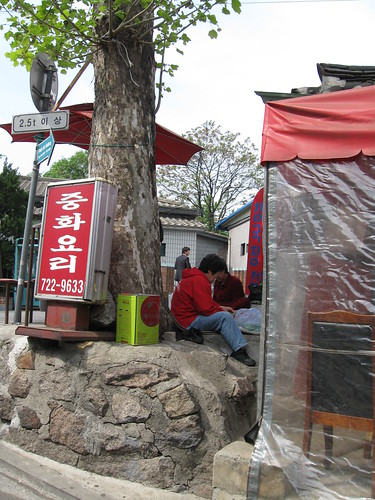
Food prep under a tree in an old neighborhood in Seoulthis well-built hanoak's stately entry has fallen from all use except as staging for HVAC. The exigencies of life and modern comforts must always be taken care of first, I guess.next door you can see the interesting stair sequence up to a second floor addition. Many of the hanoaks were modified with second floors that were built with modern construction methods. And next to that is a small Buddhist center, as evidenced by the sign with the swastika on it.across the street is a hanoak allowed to totally go into disrepair, but is doing well in spite of the neglect because, well, it's hard to abuse brick too badly. Walking past its doors it seemed like maybe it's just being used for storage. Such a pity I can't have it and fix it up!
Often I’ll see hanoaks – especially the ones with the false store-fronts, that are about to crumble. They’ve usually got serious roof problems and have tarps haphazardly stretched across them, or their roof tiles will be shedding and look like a small land-slide.
In the country, you see many hanoaks, often in disrepair as well. Some of the brick ones that have been well-taken care of, unfortunately, have had their brick mortared over so they look like concrete blocks. Others have had their traditional tile roof replaced with corrugated tin roofing. But I like the hanoaks in the country better, because so many of them have the really high raised floor and some of them are still heated with wood. I passed by (don’t know if I can find it again) a hanoak in such disrepair that I could see through its walls, which was very interesting because I could also see the lattice of branches used as lathe for the mud and straw plaster. This accounts for the thin thickness of the really really traditional hanoak walls, which were only about 2- 2 1/2″ thick.
Most Koreans are not all hot and bothered about saving hanoaks half as much as the foreigners are. They have their lives to lead, and they want to look like success and live in luxury and comfort.
Yesterday I heard yet another person considering selling their soon-to-be-inherited country home to pay for a child’s education abroad.
In another conversation I was having about Korean nationalism (due to one of my students telling me, in response to what 5 things would you bring with you on a spaceship if the earth died, she listed taegugi, the Korean flag, as something she couldn’t live without) someone told me that in an opinion poll, when asked if, in the event of war and occupation, would you stay and defend your country? The response was something like 74% (I can’t remember exactly, but it was definitely over 70%) said they would pack up and leave.
At what appears to be an almost brand-new rectangular box of a home on my block, in the yard is an equally new wood-fired oven with a huge iron cauldron nestled in it. I see the owner stoking the fire and boiling things in it all the time. So I think that even though the traditional forms are abandoned, some cultural things will never disappear and the Korean people will take them with them wherever they end up. It’s as if Korea as a nation is already disbursed in their minds, even though they live here. In some ways maybe they share a parallel kind of post traumatic stress statelessness like Jewish people must have, even though their occupation is over and they live in their own homeland. There is some deep-seated insecurity they have that manifests itself in the extremes of both nationalism and lack of loyalty: they don’t think they’re good enough or deserving enough and yet constantly work at self promotion and checking their rage and resentment towards everything they covet. When, damn it, I look around and it’s so beautiful here and they have everything a person really needs to make themselves happy. Grass is always greener, especially here. And so they kill themselves pursuing this mythic Korea while dismissing and not believing in the Korea they have.
Hope I’m wrong, but that’s the way it feels to me.
Even though I live in the country, it’s nice to get away sometimes. And, because I’m surrounded by beauty, I thought I should check out some of the local sights. My friend Clara was all pumped to have a relaxing weekend away from Seoul, so the two of us headed east.
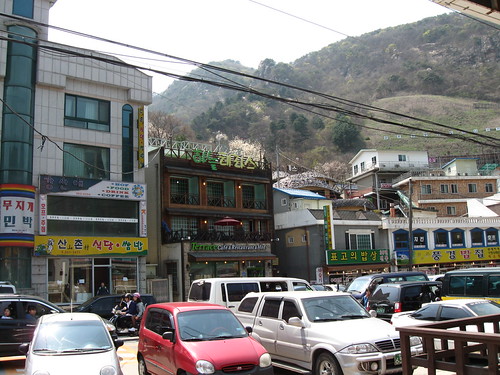
Doing research the way I love to do, I found way too many things. This region is not rife with historic artifacts like the southern region is, but it IS full of sublime vistas of natural beauty. So, to get our feet wet I chose Gangchon and Munbae, and then a brief un-planned circuit of Chuncheon. The timing of pre-season May was perfect, even though many of the famed flowers were not yet in bloom, because right now the trains east around here are so packed with Koreans escaping the city that it’s hard to get a seat and every remote path and every lodging is booked, and even then it was a bit crowded. So here are some photos from our two day get-away.
Seoul residents get off at Gangchon Stationeven the train station is picturesquethe little town hugs one side of the riverIt feels kind of wild west in a Korean kind of way
We rented bikes and followed signs up to Gugok falls. Which was really a workout for us soft English teachers using bikes whose gears didn’t work!
one of the pretty bridges on the way to the falls. would like to come back when the trees are in full leaf.Clara and I stack rocks, praying to Budda to deliver us from lonliness. This stack is NOT one of our creations, but someone with infinitely more zen than either of us.maybe if stacking rocks doesn't work, making an asian heart pose will...Gugok fallsWe crested the ridge in search of bi bim bop in the tiny village of Munbae, which means wild pearThis little guy was here to greet us, along with his very drunk master. While Clara cooed at the dog, I wa more interested in photographing the log cabinstaying warm in a small village is a lot of work
After we got back to town, we stopped for cappuccinos and had some fun hitting balls in a batting cage (and I missed 98% of them!) Then we tried to find a place to sleep for the night.
not up to U.S. codes, but way more interesting
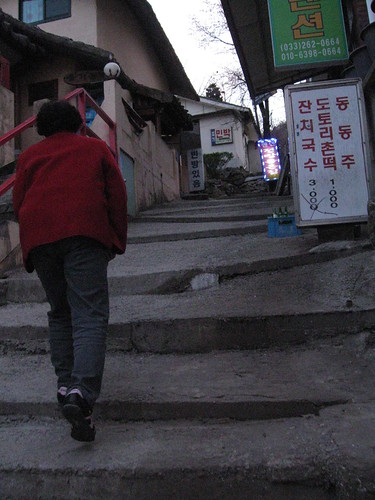
An enterprising ajumma tried to get us to rent a room from her and she lead us up these stairs to check out the room, past the sauna below:
We have one of the broken pot covered roofs in CheongPyeong too. Don't know how if these are traditional or not, but they certainly are a pleasing organic form.
We decided it was too early to retire and waited at the bus stop to head to Chuncheon. It was running late, so we brown-bagged some makkolli and enjoyed our wait in style. As soon as we got to the bus terminal, we asked a taxi driver to take us to a cheap hotel (well, Clara asked for a cheap hotel since she took real classes and can speak survival Korean whereas I can barely speak at all) and we watched a movie.
In the morning we checked out and walked around Chuncheon – which is, really and truly, one of the most beautiful cities in the world because not only is it surrounded by mountains, but also it chose to preserve its lake-front/river-front location with public access, parks, and amenities, and all the bridges crossing it are a visual delight.
one of many lovely bridges in Chuncheonwalk of pain -- err, foot reflexology path at the river-side parkWe decided to take a ferry to Jungdo island in Chuncheon, and walked past a lovely museum grounds. It was like out of a movie, as they were playing classical music, and people were sitting leisurely in its garden looking at this view.
The island was like this giant picnic spot and it was a real family place. It also had cabins for rent. We stopped and napped under a tree before heading back to our respective single foreigner English teacher lives to prepare lessons for the next day. It would be nice to just be a tourist in Korea. Superficially, this is an awesome place to visit, but the jury’s still out on if I’d want to live here. I guess like most places, the good and bad kind of cancel each other out. I’m sure it is different for those that have meaningful relationships.
I just watched Kwangmo Lee’s 1998 film, 아름다운 시절 “Spring in My Hometown,” and I’ve got a minute so I thought I’d share what little I have with you about springtime in the country.
This is a beuatiful film, btw, if you can find it. Set during the war in a remote village far from the fighting, it follows the daily life of a primary school-aged boy as he deals with the war’s indirect effects on his life and that of his best friend. A feast for the eyes, it takes some will to sustain one’s self for the pace, but that device parallels what the boy must also go through. Explaining little, with the only context being silent movie-type insertions marking the date and giving a brief synopsis of the contemporary situation, the boys and the viewers must try and make sense out of the changes happening around them: to their families, to their traditional values, and to their society. It’s blissfully devoid of melodrama because its dramatization is loosely based upon the director’s own life and took 13 years to make. It was especially captivating for me to have a glimpse of what life was like in Korea just over a decade before I was born, portrayed with such nuanced detail, thanks in no small part to the movie’s slow and studied pace, which insists on appreciating everything.
As I said before, winter seemed never-ending this year, and even worse here in the mountains as it’s about 5 degrees Celsius cooler up here and the heat was turned off as soon as we got above zero. One day in May we were wearing coats, shivering, and the next day sweat was pouring down my back, overdressed and unable to handle the heat and humidity in the 20’s. I asked people about the weather, and they told me there would be no spring this year, only summer. But of course, they are just joking as we’re all dreading (me more than anyone) the 90+ degree heat with 80% humidity that will come when actual summer begins.
a few houses from my apartment – poor man’s bathroom roof fix
Despite the weird weather, the cherry blossoms were right on time. As in Japan, people are all about them and everyone was stopping to take photos and close-up shots of them, etc. As beautiful as it was, it didn’t really lift my spirits much, because they didn’t seem to break the monotony of the neutral-colored landscape as much as hoped: the sky and denuded trees and ground were all gray, and most of the cherry blossoms were white, so it looked more like snow and didn’t detract enough from the stark background.
But magically over-night while I was sleeping, the deciduous trees became fluffy and green and some purple azaleas and blue and yellow wildflowers started appearing and despite the weather going up and down, these mountains began to look comforting, in the way over-weight people are always so comforting to see when you’ve lost faith that times will ever improve.
Most days I forget my camera or leave it home to not be burdened by its weight, but here are a few shots I took during this period, as I was on my way to school or to Seoul.
Watching the Rice Grow
hardening off / ventilating the rice under the cold frames
finally safe to remove the cold frames and irrigate the whole field
soon this green carpet will be distributed evenly across this whole field
preparing the trays for planting
adding row cover and stakes
I always enjoy walking through the rice field on my home from the subway
Stream Engineering
Every day as I passed by the river on my way to school, someone who likes using a back-hoe was playing giant sandbox with the river. Curious as to what they were doing, I started taking photos:
It began with the creation of some artificial sand bars
and then moving a few of the stepping stone slabs
Then this channel was created
and the water ran REALLY swiftly through its occluded opening
I thought they were finished, but then they moved to the other side and did the same thing. I’m guessing it was for erosion control. Glad they put it all back to look like it was.
Little Moments
This is the entry sequence to a tiny nondescript place Willie and I passed by that took my eye, even in the dead of winter. I had to walk back one day with a camera, as I want to shoot it again when its grapevine is in full bloom.
This will probably be the coolest, loveliest place to be in all Korea come August. I love humble places that are also well-cared for. So much can be done with five feet, in the space between buildings.
To Market
So I was always confused about the date because the market was popping up inconsistently. It turns out that this is one of the 5-day markets I had heard about, that has been a rural tradition for God-knows-how-long.
It pales in comparison to the traditional markets in Seoul, but it’s also very much alive and people here support it, as the Supermarket and the mom & pop stores are pretty expensive (in relative terms). Plus there are tons of variety of pretty fresh seafood the market can’t possibly store.Dongja told me that all I need to remember is “2” and “7” and those will always be the days the market should appear.
two things you can never have enough of in Korea: garlic and shade
It’s a big operation for the stall owners, setting up and breaking down every day, but it’s also kind of a magic thing for me, as I walk through their industry on the way to school and am thankful for the canopy covering the street on the way home.
I’m still too ignorant to know what to purchase there, but I’ll try to support it when I can. I bought a plastic colander’s worth of mountain greens for 3,000 won and am eating fresh halmoni-hand-picked salads.
Less hungry in Korea
I explained my eating problems (being denied most menus because I’m single and not being able to read the menus if I find someone to serve me) to Dongja, and she took me to two places where a single person can eat.
The one place she took me to I wasn’t very excited about: a typical kimbop place that serves a lot of basic Korean dishes with mediocre quality ingredients for about 4 bucks. There are two of these in my town, and to be frank, after a year of being relegated to only these kinds of restaurants I never want to eat at them again. (but do out of sheer desperation) I’m sure I’ll feel differently when I leave Korea and miss the food, as these dishes are hard to get in America, since most of the American restaurants only serve the pricey BBQ or chopchae…The other place I can’t get enough of. I’d written about it earlier, but today I have photos:
This amazing spread costs about 7 bucks.
6 of some of the best side-dishes I’ve ever had, (one of them is a bitter root that I love but many don’t like) a home-made bean paste (with snails) to spread on your lettuce wraps, a relish tray with marinated vegetables to add to your lettuce wraps, steamed pork, and five kinds of lettuce leaves: sweet red leaf, the perfumey perilla leaf, the spicey mustard leaf, green leaf and kale. Plus a seafood tofu soup.
I get a little annoyed when people try and compare the spiciness of Korean food to Mexican food. Serrano chilis are not used here, so it doesn’t get as hot as that, but Korean chilis are on par with the hottest jalapenos. So technically they are right, but I also think that the spiciness of Korean cuisine is also a different kind of spiciness than Mexican. For example, eat a lot of raw garlic and your mouth will burn, but so will your stomach. So the combinations can do equal damage but It’s only as spicy as you want it to be, depending on the dish. Because you can choose to leave out the raw garlic and hot pepper if you want, which most westerners do, they don’t experience it the same way a Korean would. This dish, for example, can blow your head off – if you want that. For this dish you can add raw garlic and raw jalapenos. It’s like Mexican with a deeper burn.
It’s not just amazing in quantity, but it’s just a gourmet feast for the senses. And I call this a gourmet treat because the way in which you choose to assemble your steamed pork lettuce wraps can result in a myriad of flavor combinations: a mustard leaf with a sweet side and garlic will taste entirely different than a perilla leaf with garlic and jalapeno, and red leaf lettuce with a salty side and a sweet side will be totally different and you can play around with your own preferences of bitter, sweet, salty, and hot.
I’d eat there every night if I could afford it, but I’m eating dinner at school for 2.5 bucks, so I make a point to go at least once a week. The owner is very kind and I think she makes me dishes that normally would be denied a single person so that’s just awesome, plus she always gives me enough side dish portions for two and lets me take the leftovers home if I want.
School Spirit
Now that winter is over, the entire school is on a high supporting the school’s soccer team. Their past successes have brought the school an astro-turf sports field and a new gymnasium is being built. Which might not impress you, but in Korea it’s rare. Most of the schools have dirt assembly yards and not many have gymnasiums and the students are forced to do all physical activities in the elements. The soccer field here is like a big giant romper room for the whole community here, and the students sit on it in groups, like you would at the park. And it’s such a relief to look out at mountains and green (even a fake green) field than it is to look out at a sea of concrete buildings and a dirt yard…
Two weeks ago we had a sports day, where the different grades competed in soccer games against one another, so classes were canceled that day and each of the classes dressed up to support their team. It was really exciting!
some of the female teachers, avoiding the already merciless spring sun
my students looking on – excited to be out of uniform
I think this photo shows the wide range of personalities that exist in this collective country and also how lovable the students here are
The days are flying by. I kind of freak out because I’m always scrambling for the best content for my lessons but falling a little short. I often end up giving the 3rd year students the same thing as the 2nd year students, because the 3rd year students will be leaving and not have to cycle through it again. That also buys me time to come up with something new for the 2nd year students the following year. The first year students are the biggest headache, though. Because the school is changing to an academic high school beginning with them, there are more girls, larger class sizes, and higher English levels also more attitude. So it’s not as bad as Baekyoung, but that is the future here.
Since last weekend where commuting daily from Seoul and couch-surving, getting only about four hours sleep and taking the first train to CheongPyoeng to make it to school in time, I’m falling asleep as soon as I get home and waking up at midnight…this is not good…
Anyway, just wanted to pen a quick note before I write tomorrow’s broadcast and fall back asleep. It’s going to be a little thin for awhile. Working on a huge project to be unveiled in June, and will be pretty much sleep deprived and out of commission until that time. So much to write about, yet no time!
Also sorry to have written so much about adoption lately: things are heating up here politically and personally: adoption day was this Tuesday, and our the TRACK/ ASK / Miss Mama Mia coalition bill to improve social services to families was presented to the National Assembly that day. I guess Jane went as a kangaroo!
note to myself: spring has arrived, visiting Gugok Falls, Munbae, and Chuncheon in Gangwon, open classroom, lost my wallet, rice paddies all irrigated, starters uncovered and planting should be soon.
…resides in some of the following people I’ve had the pleasure of getting to know:…
Tori
She’s an adoptive mom who’s seen the light and realized adoption is not about her, but about what’s best for the children. She’s tirelessly fought to reunite her children with their families, and here is the result of her efforts:
Tori's son and his grandmother meet for the first time
The entire family is learning Korean and hopes to return annually to spend time with the boy’s biological extended family.
Greg
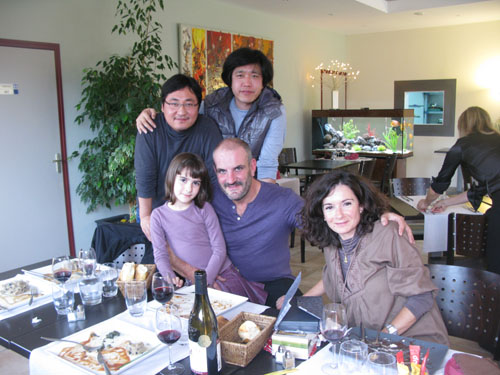
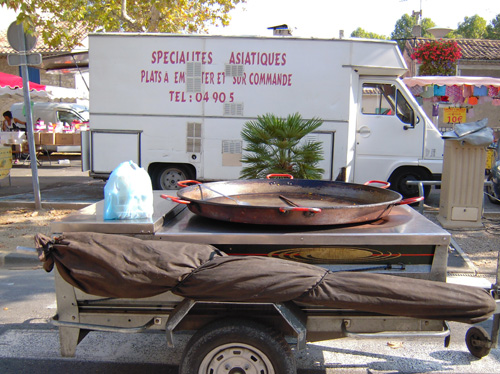
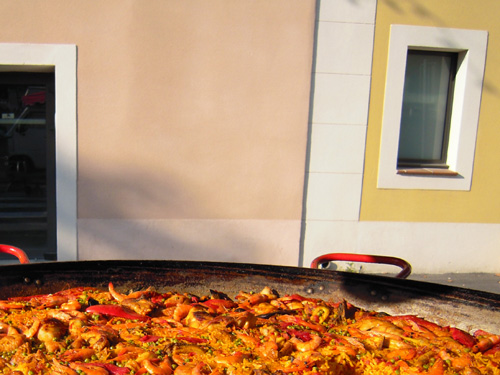
Greg is this gentle giant with a huge heart. One day a week, he sells Paella in the market in Provence to support TRACK. Not only does he support TRACK, but he also supports two children’s homes in Sri Lanka.
Greg, his family, and the KBS film crew
family preservation is humble workbut oh so satisfying
Greg is the most generous, thoughtful, and proactive person I’ve ever not met! He always talks about how beautiful and wonderful life is, and his work is always about making a brighter future.
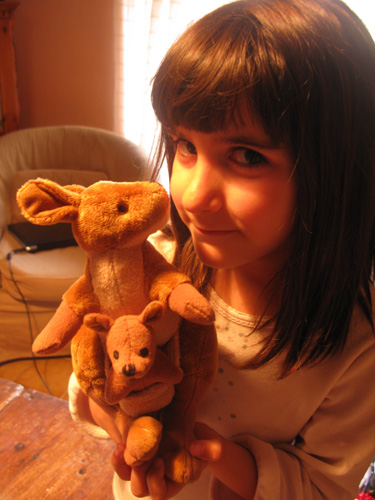
Greg's daughter Carla, holding her doudou -- which I'm told is French for security blanket -- and isn't it lovely that her doudou is TRACK's new mascot!






 This is a beuatiful film, btw, if you can find it. Set during the war in a remote village far from the fighting, it follows the daily life of a primary school-aged boy as he deals with the war’s indirect effects on his life and that of his best friend. A feast for the eyes, it takes some will to sustain one’s self for the pace, but that device parallels what the boy must also go through. Explaining little, with the only context being silent movie-type insertions marking the date and giving a brief synopsis of the contemporary situation, the boys and the viewers must try and make sense out of the changes happening around them: to their families, to their traditional values, and to their society. It’s blissfully devoid of melodrama because its dramatization is loosely based upon the director’s own life and took 13 years to make. It was especially captivating for me to have a glimpse of what life was like in Korea just over a decade before I was born, portrayed with such nuanced detail, thanks in no small part to the movie’s slow and studied pace, which insists on appreciating everything.


 Hello Korea !