Don’t know where to file this

Four blogs to compartmentalize my complicated life, yet I don’t know where to file this:

New discoveries about adoption in Korea.  While doing research for TRACK, I keep coming across new horrible things:

New unwed mothers homes and name changes


ESWS opened new unwed mothers home and changed their names.


Location

Before

After

Pyeongtaek

Esther’s Home

Esther’s Home

Seoul

Sharon’s Home

Saengmyeong Nuri

Gyeongbook

Sharon’s Home

Sharon’s Home

Anyang

Sharon’s Home

Hanbit Nuri

Daejeon

None

Hatssal Nuri

Incheon

None

Seum Nuri

Jeonju

None

Gippeum Nuri

Maybe that doesn’t seem so horrible to you, but in Korea, there is no time limit between birth and relinquishment like there is in most other countries.  That means the mothers are never given the opportunity to bond with their babies and possibly experience what they might be missing by relinquishing.  This means that mothers can relinquish while the children are in utero.

This practice used to occur in the United States and Australia, but was OUTLAWED because it essentially exploited vulnerable girls. (often at the behest of their parents)  These homes for unwed mothers were called Baby Farms, because privileged people who wanted babies to adopt were essentially cultivating them…

Even more horrifying to me is that the adoption agencies RECOGNIZE how traumatic this is, and hope to ameliorate it with ceremonies to facilitate closure.

There are many kinds of farewells in this world. All partings are heart
wrenching but is there one more painful than that of a baby separated from its mother as soon as it is born? Though the baby cannot express itself, the distress it causes is quite real.

At the same time, the distress caused by the separation is also enormous for the birth mother who has relinquished all rights to the baby. There is a report that identifies undeniable effects to the birth mother after her decision to give up her baby for adoption. In her report about Birth Mother Syndrome, Paik Yun Oak writes that giving up the right to a baby is like a living death. There is a finality to a typical death but in this living death, a mother who has given up her baby must cope with the range of emotions that comes from one extreme which is the hope of one day perhaps being able to meet her child and the other extreme, her current unbearable hopelessness. Mothers report repeatedly dreaming about losing their babies, fantasizing about marrying the fathers of the babies and living happily together, denying ever having given up their babies for adoption, losing themselves in alcohol or drug addiction or promiscuous sexual behavior. There are some who report having lost all memories of the birth or adoption, having bitterness towards the person who recommended adoption, feeling extreme isolation, living with guilt and shame and with the fear that she will be punished or in extreme cases attempting suicide caused by depression. In addition, these mothers are reported to have very low self esteem in raising their children after marriage and question their parental competence.

At Esther’s house, we aim to not only provide housing and prenatal care for safe births but programs for psychological support so that birth mothers can ease their loss and increase their confidence. According to Director Lee Kwang Mi who plans and oversees these programs, “many birth mothers experience much psychological pain and because there is so little to help them assimilate back into society and their previous lives, I have keenly felt that we need a rehabilitation program. As such, at Esther’s House, Choi Seung Hee, a social welfare Professor from Pyongtek University provides a loss program, farewell program and a confidence program for birth mothers.” Academics have reported that if a birth mother does not see her child or does not go through the process of saying good-bye, her ability to overcome her loss will be much more difficult. In this environment, accepting the reality of the adoption and being allowed to say good-bye allows birth mothers to accept their situation and lead a much more enriched life.

In our magazine, we describe a “farewell” ceremony for the birth mothers at Esther’s Home.

The ceremony began with a prayer by social worker Chang Bo kyung on behalf of the mothers who have decided to say farewell so that their children could have a better future. There were four babies in the middle of the hall. Even before the prayer began, there were sounds of sadness from the mothers. A birth mother stood by the foot of her baby with her head hanging down in tears and sadness. Once the prayer ended, Esther’s House employees took square pieces of paper to make a stamp of the babies’ feet and cut locks of hair. These will be passed along to the birth mothers so that they can cherish it.

Following was a time for reading letters by the mothers to their babies. The mothers each read a letter that they have written. Mothers read and stop overwhelmed by emotions and then read again. The mothers cried in sorrow because this might the last chance for the babies to hear their mothers’ voices.

Soon thereafter, the director of Esther’s Home, Lee Kwang Mi read a poem about birth parents and adoptive parents entitled “Legacy of an adopted child”. The director then asks the mothers to promise that they will pray for their child at least once a day and the mothers respond that they will. Then she prayed for the birth mothers who have physically and psychologically toiled and for the babies who will meet new adoptive parents. Then she approached each baby to bless them so that they will meet good families and grow up to be fine people.

The official part of the ceremony ended thus and the employees left the mothers to be with their babies. The mothers held on to their babies who have no idea what is happening and murmured words of love and sorrow. Mothers cried “baby, I’m so sorry. Your mother loves you so much. I will look for you later… I am so sorry.” Babies who had been born only three to four days ago stare up at the ceiling, only to start crying when the mothers hugged them hard in their sorrow.

The babies were then taken on a van to a temporary care center in Seoul and the mothers sat there in their sorrow unable to move.

The tummies of young mothers are now back in shape but the pain was added in their hearts. We should help them heal the pains in their hearts

Um, how about not cause the trauma to begin with and help these girls keep their babies?

Eastern Social Welfare Society is a licensed, nonprofit organization dedicated to finding nurturing homes for children. Founded in 1972 by Dr. Duk Whang Kim, ESWS has placed more than 35,000 children in loving homes in Korea, USA and Australia.

This is not the 1950’s. This is still happening TODAY.

Ugh. And try this one on for size…

“CHANGE THE IMAGE OF ADOPTEES” PROJECT
ESWS 06.04.07 51

Victims, orphans, sadness, unstableness, and anger are the images that Korean media have created for adoptees who live overseas. This kind of images made Korean people feel sympathy on overseas adoptees and treat them with pity, which a lot of adoptees feel uncomfortable about.

ESWS is trying to change images of adult adoptees to a more positive way by showing they are happy, generous and mature adults who contribute themselves to this society.
———————————————————————-
PROJECT #1> PUBLISH THE BOOK BASED ON THE SURVEY OF EASTERN ADULT ADOPTEES

ESWS had a survey for adult adoptees in the US and Australia last year. We traced where they live, what they do and have achieved and what they think about adoption. The survey turned out that many adult adoptees are well-educated, mature, strong, smart and well-rounded. Thus, ESWS decided to publish a book on the survey results to help change the prejudice of Korean people on adopted people. This book will mainly focus on the present and future of Eastern adoptees, rather than on the past that most media have focused on. However, we are in need of budget to publish this book.

To publish the Korean version, we need approximately
USD 3,000 for 500 copies. If you send sponsorship money, we will publish your name in the book and will send a copy to you. Photos and comments are welcomed.

I don’t think they want my photos or comments.

And if a fellow ethnic Korean who WASN’T adopted has pity on me, then so be it. Anything to put an end to this madness. I am a well-educated, mature, strong, smart and well-rounded adult adoptee who contributes to society by being really fucking angry and working for social change. Getting rid of international adoption agencies who contribute to baby farming and send 35,000 children away from their cultures sounds like a pretty positive thing to me.

Not ready for prime time

Sigh.

So here’s the KBS show I was on, “I miss that person.”

I wince thinking about this and posting it, but I know some of you would like to see it.

Just a disclaimer, my face is contorted a lot of the time, because I’m somewhere in between trying to smile and trying not to cry.  And I sound really awkward because I’m somewhere in between talking extra s-l-o-w, and to stop often so she could translate, as the interpreter asked me to, weirded out because I have to answer questions from people to my left and right yet look straight ahead at the camera, and trying to control my emotions while trying to remember (badly) what I wanted to say.  So the end result is something strange and full of ticks.

Sorry there’s a little overlap and you’ll have to hear a little of it twice – It took a whole day to rip this, and then another half day to upload it, so I’m just going to live with the mistake…sorry…

By this time all I could think was, “can I go now?”

The woman with green hair and clothing is supposedly a famous author.  She’s always on this show, and I guess her job here is to be something like a rodeo clown.  To break the tension or add another voice & distraction.

By this time I was totally not present anymore, so I couldn’t even think at all.  Stupid.  There were some activist points I wanted to make and some thought provoking things about adoption I wanted to say. Then another guy went on and his story was interrupted because of the phone call.

Well, that’s it.  It’s been two months and there’s been no follow up contact since they called to tell me they’d found my aunt and then called to tell me it was a false lead.  So I have no idea what’s going on with the investigation, or if anything the man who called in said was true or not.

But the interpreter Eun Seong is now my Korean tutor:  She’s great, and it’s costing me the same as if I went to a University class, only I’m certain the one on one instruction is better than what I will get there, at least to start with.

Tomorrow it’s more of the interview for that magazine and to get photographed.  Oh God, why can’t I take a good picture? I’m actually really pleased about being in this magazine article, because it’s not a one shot live thing, and I was able to say something meaningful and important.

And I’ve no idea when the YTN news segment aired or is going to air.  When they’ve finally posted it on their website, I’ll provide the link for you.  Hopefully the editors can cut out my weird ticks in front of the camera…

You can have your officetel

Once upon a time, most everyone in Korea lived in hanoks.

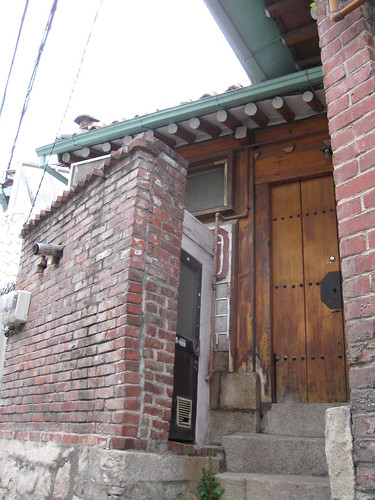
There is an entire hillside village in Bukchon of extant hanoks, still privately occupied, which I walked around and photographed.  One grandma was opening her door and I got to peek inside for a second, and let me just tell you, the courtyard was absolutely gorgeous.  I’ve no doubt that this is old money who own these hanoks, and I would call them estates even though they are not that big.  A lot of imported cars like BMW’s in the drive-ways, so you have probably got to be well-heeled to own one of these, and it’s probably been in your family forever.  I read that some of the hanoks in Seoul had to be re-built in the 30’s because the Japanese occupation partially destroying some of them.

What’s interesting also is that many of them sit atop modern garages, so they must have been shored up and the garages excavated under them.

All around Seoul, here and there, you can spot the tiled roof of some hanok in total disrepair, squeezed in between and behind some run down commercial establishment, for example.  These aren’t long for this world, I am sure.

I took a million photographs of these up-scale hanoks, but here are a few select photos for you.

These places are like impenetrable fortresses!

Many of them had a short door off of the entry steps like this one – I was wondering if this was the location of the original latrine, and maybe it drained onto the street or into a sewage gutter at one time.

As you can see, there are sooo many textures in Korean architecture.

I was really surprised when I first got to Korea, how much brick there was.  And stone.  I had been expecting all modern materials or something less muscular.  But it’s all about rock, earth, and heavy timber here.  I kind of like it…It’s not as dainty and refined as Japanese architecture, which is more about all wood frame construction.  Would take some study to discern the guiding principles and compare.

Note how the stone of the old walls has been cut into modular pieces.  They do not have their mortar pointed, but it extrudes out.  And yet they took the time to flatten the extruded mortar all on the same plane, so it looks like a frame.

This looks to be a restored roof:  I took this shot  so you can see the huge amount of build-up to the roof structure.

What looks to be white painted timbers in many of the photographs, sticking out from the roof tiles, is actually extruded mortar.  This less refined example clearly shows that.  Also note how large and how far the metal gutter system extends.  On more prime examples, the corners where gutters intersect are fashioned into lovely points, making the entire heavy roof system more poetic and lighter.

Like this…

One lower elevation hanok was open for visitors, but the interior was being remodeled and closed (of course) so I only could get as far as the courtyard.  From there, you can see at the top the metal whimsical downspout, and at the bottom, you can see how the ondol floor heating system is still intact here. (note the bricked-in portion beneath the floor level)  For those of you who don’t know, Koreans used their crawl space as a horizontal chimney, which radiated the heat from the cooking fire across the length of the floor.  This provided maximum fuel efficiency and comfort during the long winters, and the heating coals also provided an always ready source of heat for cooking soup, stews, and steaming rice.  This is why Koreans sleep on the floor, and why they throw water on the floors to humidify the stuffy winter rooms.

There were also some lower class hanok still extant at a lower elevation, and here is what the entrance alley to those hanok looked like.  Pretty charming and cozy.  I wanna live there!  Not in one of the fancy schmancy ones on the hill, owned by the Yanban (scholarly elite) but something simple like these.

Just add me to this picture:  A hanok, a motorcycle, and me.

Yeah, I could live with that…

Saturday afternoon in Insadong

So I’ll skip over more photos from the Folk Museum right now, because it’s a huge project.   But after the folk museum, I headed to near-by Insa dong, which is a yuppified revisiting of what a traditional street was supposed to be like.  But it’s nice, despite the obvious pandering to tourists, because it has become a magnet for antiques houses and some traditional crafts for sale.  Plus it’s always good to go to a street that’s been blocked off from car traffic…

So just to give an idea of Seoul, this Samsung building is kind of the anchor of Insadong.  This is the kind of crazy mix of sci-fi and centuries of tradition that co-exist here.  But the sci-fi wins…

Kids and cops were out in full force due to the holiday weekend.  And they were ready with riot gear, due to it being the anniversary of the American beef import riots.

Example of Insadong merchants – here’s a place with hand-made brushes that can come up to sizes as big as my (literally) head, along with manuscripts and gee, Chinese fans and lamps…

The feeling is lost in this photo, but here’s a modern boutique mall in Insadong, of a really nice accessible scale and open to a courtyard.

Seating in the courtyard – and yes, Sara, everything in Korea is cute!  Especially the little kids…

Today is Children’s Day

It’s a national holiday here, so parents can actually spend time with their children.  It’s kind of like Christmas for the kids, as this is their major gift-receiving holiday.  My high school kids feel kind of jipped, however, as they already were getting the time off because they just got done with midterms, and because they stopped getting presents in middle school.

So today was made to celebrate and honor Korea’s progyny and future.  I guess this is the one time I wish I were volunteering at an orphanage, to let the kids there know somebody wants to celebrate and honor them too.

Speaking of charitable acts, Willie and I were talking about how nobody in Korea wears old clothes and we were wondering where they went, because a lot of children in third world countries could use these well-made, barely used clothing.  Anyway, I noticed in the vestibule at E-mart a drop-box for clothing donations, so that’s awesome for me, since damned if I’m going to attend one of those cult-like Korean churches…(the cult description is no joke – people literally hand over their lives and most of their money to a lot of these churches, and some of them have ideology that is WAY out there…

Next week is national adoption day.  I guess it was made to promote domestic adoption.  And as long as there is that quota of 1:1, then I am sure Holt and other International adoption agencies want it to go well.  What will it take, I wonder, for them to close up shop and go back to the west and stay the hell out of Korea?

It’s going to take Jane getting her degree in managing an NGO.  It’s going to take TRACK getting domestic and international laws re-written with the National Assembly.  It’s going to take OAK creating programs for unwed mothers.  It’s going to take the voice of all of us 500+ returning adoptees.

Maybe if the current unpopular president takes international adoption on, just like he took on importing American beef last year, then there will be rioting in the streets and demand for an end to it.  (there was a protest Saturday commemorating the one year anniversary of the beef protests, which shut down the Hi Seoul festival. While nobody here trusts American beef, the protests were more about the president’s close ties with the Bush administration)  Ack!  That’s just wishful thinking.