Anyeonghasayo means, “have you eaten?”

Well, now I can say I have, since I purchased the gas  stove.

I thought I was going to have to live on street food all month or lentils and rice from the rice cooker Jane gave me.  For some reason, my paycheck was short $200 this month, and of course I couldn’t figure out why because my salary statement is all in Korean.  All I could think when I realized I’d been shorted was, “Great.  Can’t ANYTHING go right for me lately?”  I took it to my handler today, she investigated, and it turned out the accountant had thought I hadn’t paid any taxes all year and had decided to take out $200 at a time.  After it became an issue, he magically found record of me paying taxes and agreed to reimburse me the $200 IN FEBRUARY.

I told In Kyung sarcastically that I needed to go on a diet anyway.  But then I just got angry that I’d have to wait until February and I told her I really wasn’t kidding when I said I couldn’t afford to eat this month, and that I really shouldn’t have to suffer because somebody else made a mistake.  So I get a text on the way home that the reimbursement will be in my account in the morning.

Yayy!  AND I found my long-lost jewelry I’ve been missing for months.  AND I woke up two students today who HADN’T given up and were actually HAPPY I woke them up and saved their butts.  AND during the after-test-partying some of those boys who’d been so rotten to me where saying, Sung saeng nim!  Please have some! (of their food) and smiling at me.

So on the way home I stopped at a used appliance place and bought a gas stove top for 30,000 won, which was really exciting because they cost 50-60,000 new for the same basic model.  The real estate agent Choi, who also calls me Jane like the doorman did,  (I guess it’s just habit to call people by the second name they see) arranged for the gas company guy to come right away, and in fifteen minutes I had a working range.  (but the hook-up cost another 35,000 won, unfortunately)  Mrs.  Kim tells Mr. Choi she wants to give me kimchi, and he starts rummaging through my cupboards and drags out the biggest storage container.  Choi tells me she was going to bring me a whole lot, but will only bring me little by little because I have no refrigerator.  Her little by little could feed me for a month, and she puts it outside my door because I can’t afford a refrigerator next month.  So this means I now have to eat mass quantities of kimchi so she doesn’t get offended, especially ’cause she can see the amount I’ve eaten and check on it each day!  Mrs. Kim, bless her heart, sees my condiments sitting on the counter and starts repeating their names for me in Korean so I can learn them.  I kind of wish I lived upstairs with her, since I’d like to have her around more to teach me and smother me with misplaced motherly attention.

So things are looking up.  I just hope I can find a decent job so I don’t have to burst this happy little love fest.

Oh, and guess who one of my students is for my small group conversation class during winter camp?  That’s right – Tae-in!  I just hope the other student doesn’t leave when she sees who else is in the class…and I hope I can somehow impress upon this Asperger’s Syndrome boy that other people have feelings and to not just blurt out whatever he’s thinking and that his thoughts are more important than everyone else’s…I guess this is my payback for having had nothing challenging or educational in my lessons this past month.  But for some reason Tae-in thinks we are best buddies, so I’m also hoping that I can accomplish something with him.  I just wish I had some training in psychology or learning disorders.

But yeah, today was a good day.  So now I have to go buy some staples I can cook on my gas range that don’t need to be refrigerated!  I’ve got to make the expense of the stove and gas hook-up balance out, so must put on some kind of creative hat or else I’ll be tempted to eat out everyday.  There are two medium sized supermarkets w/in 500 meters, as well as a small one just 100 meters away.

home basement home

Mrs. Kim's kochujang and dwenjang pots in my yard
The little garden area outside my door
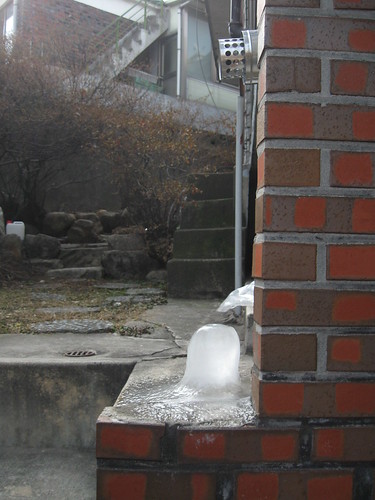
This is the condensation drip under my gas heater's vent
A little Korean kitchen, minus the yet-to-be-acquired gas stove
the karopi rug has a new home
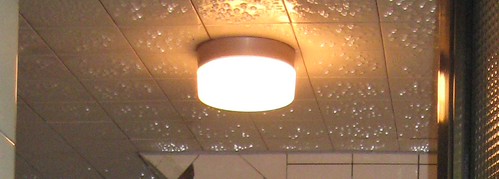
the condensation looks pretty in this picture but doesn't feel so pretty when it drips on you
A Korean shower room - note the high tech washing machine!
quite possibly the largest, shortest, bathroom in Korea - ceiling is at about 5'-4"
without shelves, the floor will have to do - note my "couch" a Japanese padded folding seat.
As you can see, life revolves around the power strip and the blessed humidifier.
Thank God I bought those fold-out sitting mats this summer, or I'd be sleeping on only floor right now!

There’s a billion photogenic street scenes of my neighborhood to come, as soon as I can brave a few hours running around in the cold.  Right now it’s 4 a.m. and I should crawl under my new moving pad, er, blanket, and get less than three hours sleep.  Two more half days of test test testing to go.

uri nara

Math final exam last Friday.

Two boys have their heads down and are sleeping five minutes into the exam.  I go to wake one up and he’s pissed.  He looks over the test for a few minutes and lays his head back down.  I point out the other boy and the teacher (I can’t remember his given name, only that he is yet another Kim) does nothing.  And so begins a long discussion (on the back of an extra exam) about education in Korea.

“Isn’t that boy also worried about entrance into college?” I ask.

I learn that some students give up on college in high school, and some as early as middle school. I tell him about the GRE in the US and that some students who hate high school choose to quit early yet are still able to go to college if they pass.  I tell him that even some smart kids take the GRE because they are bored and want to go to college early.  They must start out at a lower level college, but that it is easy to transfer.

He tells me that there is also a high school equivalency test in Korea, but that it is shameful to take it so most suffer through high school.  Others give up on better colleges and, knowing math won’t be a factor in the second or third tier type of college they’ll be going to, probably in the countryside, that they don’t even bother to study math.  They think they can also transfer once they complete some of their college courses, but transferring to an upper level school is very hard to do in Korea.  He tells me that even though 80% of the students go to college, that it doesn’t mean much since most of the colleges are no better than high school.  He chuckles, “there are more colleges than there are students, you know!”

I forget to ask, but later remember that nobody can ever tell me why Korea doesn’t improve its college accreditation?  So that an entire nation isn’t competing to get into three schools…

I tell him about the running start program and how some students can get credit for college AND high school at the same time.  Turns out Korea has this too, but only for specific subjects from specific top tier schools.

We have the same discussion I always have with Korean teachers, about the hagwon system and how it undermines public school education.  I tell him that it’s elitist.  I tell him that it exploits common people with false promises of class climbing.  I tell him that it exacerbates the divisive class structure of Korean society because the super rich can always have exclusive education and dominate the competition while draining the common people of all their resources. “Why,” I ask him, “Why don’t Korean parents spend their money more wisely and efficiently?  The few gains from all this extra instruction are marginal and meanwhile their children spend 16 hours a day in school and are robbed of childhood and a balanced life.  It’s not sustainable and doesn’t make economic sense – financially or personally.”

“You’re right,” he says, “but Korean parents don’t trust the government with their money.  We could never be like Northern Europe and their welfare state.”

I explain how very different American taxes are compared to Northern Europeans who pay 50% of their income.   I explain how American parents feel too poor to pay for private institutional cram courses, and how they demand a decent public education from their government.  I explain about school funding in America, and how it is never fully funded, but how each city and each school and each community must work together to overcome the shortfall in Federal funding.  I explain how Americans typically pay 15 to 30% in taxes and how when the burden is great quality domestic programs must match that burden.

He tells me Korean parents would never participate in fund raising for their communities, because they already feel they pay too much taxes. (I later hear it is about 20% on average)  He goes on to tell me that is why they have such good health care.  He goes on to tell me how even Obama praised Korean health care.  “Obama,” I tell him, “even though I love the man and voted for him, is still a politician.  Obama also praised the Korean educational testing system.”  Point taken.  He nods.

“The thing is,” he explains, “that Korea has been conquered and occupied by other countries most of its history.  So many feel we must compete and be the best we can be so we are never in that position again.”

“I know about that history,”  I say, “but you’re not competing with other countries.  You’re only competing with each other and killing yourselves doing it.”

“That’s what I don’t understand about uri nara. (which means, our country, the Korean way of always referring collectively to themselves as one people)  Where is the uri? It seems to me that everyone in Korea is only thinking about lifting themselves and nobody cares about what’s best for society.”

After which follows a long pause.

“You’re ABSOLUTELY RIGHT,” he says.

“That makes me so sad,” I say.

“Me too.  Me too.”

Test finished, I leave.

He folds up our conversation and puts it in his pocket.

Picture Poem

Of all the teachers I’ve met at Baekyoung High School, Nine Stones the Chinese instructor is by far my favorite.  A slight man, quiet and thoughtful, he’s always smiling and genuine.  He’s also the only teacher I have any contact with who can speak no English.  (I’m sure this would reflect most of the teachers in the school, but the ones that have made my acquaintance are the few who want to practice their English, and so that would be maybe 5%) He’s also the only one who has bothered to teach me anything, which happened the time I brought a Korean children’s book to school and he showed me what the root Chinese words were.  He’s the one who’s wife is a descendant of King Sejong and whose mother-in-law resides at Sujoldang, the residence of the poet/philosopher Toegye, where we stayed in Andong.  I like him because he’s never agitated and always calm, befitting his stature as an officially recognized Korean poet.  I’m sad that without Y as translator, we don’t have conversations anymore, but somehow he always knows what’s going on with me, and he’s the one person I never fail to say good morning to.

A few months ago we celebrated because his poems got published in an anthology.  I didn’t know it until last week, after a day spent weeping by myself at my desk, that one of those poems was about me, when he gave it to me to make me feel better.  So here it is.  Please forgive me if I got some of the hangul wrong.  (those little dashes on the vowels are hard to see sometimes)  It was remarkably easy to type in, and good practice for me, even though I don’t know what I’m writing.  That’s how it is with a phonetic language like Korean:  the symbols are easy to master, the writing a quickly acquired skill, but the words, the words…

.

.

그 여자, #4708  외 1편

동행

.

.

리안제인리스 Leanne Jane Leith

.

앵두나무 꽃 핀  날 구경 건  안동 신시장

두 살적 엄마 찾는  마흔 넷 된 여자가

고무줄 한 묶음 사서 까만 머리룰 묶었다

.

카메라에 넣지 못한 내가 놓친 풍경들을

수졸덩 (some Chinese word here) 안주인과 나란히 사진 찍던

그 혀자 맨 처음 배운 한국말은 엄마다

.

.

가칭 (some Chinese word here) 서영숙 Suh Yung Sook

.

나룰 버릔 이유는

뭔지 무르지만

이 나라에 들어올 때

이미 용서한 당신

당산을

다 이ㅎ해해요

이제 니를

찾으세요

보고 싶 은 엄마가

내 얼굴 닮은 섯과

실묜서 긍금헀던

말 못한 그리훔흘

엄마는

알고 있지요

내가 누군지

알지요

.

.

The translation Nine Stones gave me (with a few grammar corrections on my part):

.

.

The woman, #4708

.

When cherry trees came into blossom, I went to Andong market with my acquaintances to see it.

Among them, there was a 44 year-old woman looking for the mother she lost at the age of 2.

She bound her hair with an elastic string.

.

She took pictures with the hostess of Sujoldang

in the background of my missing scenery.

The first Korean word she learned was “mother.”

.

.

Suh Yung Sook

.

I don’t know why you deserted me but,

I’ve already forgiven you

when I came to this country.

I understand you.

Please, search for me.

My longing for my mother

is beyond description.

Probably, my mother knows

how much

I miss her and

I wonder

if she looks

like me.

She knows me.

The mother of Nine Stone’s wife – a wonderful, warm, talented woman I wish I could call mom.

please teach me

Oh, that title could be about so many things here in Korea.  But right now it’s part of the name of a comedy from 2003, Please teach me English, which you can view here (if you download their viewer)

It’s not going to win any awards or anything, but it’s definitely amusing if you want to see how Koreans feel about English, how foreigners are viewed, and how the two interact.  The movie also briefly touches adoption in the most realistic way of all the Korean movies I’ve seen thus far.  It’s got all kinds of glimpses of Korean life which, as a person living here, I will think fondly of for many years to come.  (The same exact song to signal the end of class, for example)  And it’s got its required moments of cheesy romance and the girl getting carried. Something for everyone I guess.  But it was fun.

four more months of this?

Right now it’s -8° C (12° F)  outside.

Supposedly the low this morning was  -12° C (10.4° F)  with a windchill of -19° C  (-2.2° F), and it’s only mid December!  When I arrived last February,  it was –20° C (-4 ° F)

Fortunately, I got paid yesterday and headed down to the Express Bus Terminal, where I heard clothing could be had for cheap.  I got a pair of mittens for less than 3 bucks and a hat for also less than 3 bucks.  I should have bought more, since knowing me they will end up getting lost.

Anyway, I was reading Stephan Mots’ blog today and he wrote about an interesting proposal.  Which, of course, being from Seattle reminded me of our underground city.  As a person with Architecture training, I can’t begin to imagine the expense of the excavation.  I’m assuming it wouldn’t be as risky a proposition as in Seattle (talking about destabilizing adjacent building foundations), since Seoul seems to be one giant rock, but I also can’t see how housing units below ground could possibly get enough natural light, or what the fire escape/flooding evacuation plan would be.    What I WOULD like to see underground, in NYC, Japan, Seoul, and other cities where there are both subways AND homeless populations, is a bunk house where those with nothing can sleep for the night and take a shower.

It’s true the homeless here can and do sleep out of the cold in the warmed subway terminals, but a piece of cardboard on top of cold marble isn’t fit for anyone, (I tried it one night and it sucked, so instead I stayed up all night) and there aren’t enough benches to go around.