Speak Korean, damn it!

So for various reasons, I’ve had to take a taxi four times in the past week.  Each and every single time, I’ve been unable to tell the taxi driver where I want to go, even though I’ve only got one destination, the same one each time.

Last year, if I was running late and I had to take a taxi to school, no one could ever understand my pronunciation of Baekyoung high school. This year, no one can understand my pronunciation of CheongPyeong high school.

Last week I had to call a taxi to pick me up from school and when I told him where I was at, CheongPyeong high school.  He literally yelled at me to speak Korean, damn it!  This morning, I was running late and I saw some students waiting at the bus stop.  The local bus shelter doesn’t have any schedule or bus numbers on it, but since I saw students waiting, I figured I could grab the same bus they were grabbing.  It wasn’t until I was impossibly late before the three of us realized that I was waiting for a bus that would never come, and that the girls were waiting for a friend who had a car!  So I ran to the only taxi stand in town, told the taxi driver I wanted CheongPyeong high school, and he looked at me like I was not just retarded but purposefully trying to make his morning difficult.

So after morning broadcast, I asked my co-teacher if I was pronouncing high school wrong, and she said, “no!  it sounds just fine!”  I guess I just got lucky, because I have no idea what I did differently.  Later, having to run to the bank and back between classes, I was fortunate enough to get a taxi driver who was excited to practice English with me.  He, too, gave me a strange look when I asked for CheongPyeong Godan Hakyo.  (I’d only just this month realized it was Godan Hakyo, and not Gotan Hakyo…once again, the “t” sounding letter “d” had messed me up) and he was kind enough to say it with me several times, and he corrected me to say GoDang Hakyo.  Later I got the address of our school from DongJa, and looking at it, sure enough, the Korean hanguel alphabet letters phonetically spelled out Godang Hakyo.

Anyway, I just wanted to share that with you.  I thought being yelled at to “speak Korean, damn it!” was too funny to keep to myself!

Good Morning

The only problem I seem to have is the morning broadcasts.  I did two and the co-teachers loved it.  I had nice music for intro and close, and I had it all planned out with a sort of ad-libbed casual conversation with me and the co-teacher where I stopped the dialogue and would explain some of the finer subtleties of our conversation.  I successfully explained about respect in America, and our not formalized yet very real respect language and why I should be called Ms. Leith instead of Leanne teacher.  And all the kids call me Ms. Leith now.  The kids were actually listening!  I might be the only foreign teacher in Korea addressed in an American way, at this point!

But then I got called to the principal’s office.  He was a little upset I wasn’t using the book that Wayne teacher had written the year before for this year.  The book, it seems, cost a lot of money to print, and we had to justify its cost by using it.  Plus, everyone was confused why they hand out the book every morning and it doesn’t get used.    But, okay and I love the former teacher, as he’s really kind and got me this job, and funny and, etc.  but this book just sucks ass.  I looked at his former books and they were much better, and his first one is really good, but this one is laid out weird and is very formal in speech and some of the dialogues are college or business English kind of scenarios…and the worst part of all is it has pop songs with translations and am I supposed to lead the entire freaking school in karaoke?????????  I told the co-teacher I’m really not comfortable singing those songs, and what was Wayne thinking, was he really going to lead the whole school in karaoke?  I don’t even know half those songs, pointing out the very first one from a movie I’d never heard of…to which the co-teacher replied, “oh but these are all very famous songs from popular movies.”  Well, I told her, I guess that might be because I don’t see blockbuster movies much.  “but this was an independent film!”  Oh…

OK.  So I will use the damned book.  So I use the book and a white board and give little culture points about why what is in the book is too formal and then give examples of casual talk.  Afterward, I am told by the co-teacher that my broadcast was not interesting enough and some teachers have been complaining that I need to make flashy power point presentations.  They need to be flashy or the students will get restless and then they will have problems controlling the students.

OK.  So I make power point presentations so the other teachers can have a ten minute break in the morning.  grrr.  (remember, I’m only given an hour to prepare for these, and this bumps me up to two hours)  And I use the power points to illustrate why we don’t talk business-like with real people in real conversations.  Afterward, I am told there have been complaints that I do not speak loud enough.  I complain back that the mike should be turned up and the co-teacher tells me my mike is fine and I need to talk louder.  Meanwhile, I can hear her mike but not mine.  So now I have to yell unnaturally if I get the wrong mike…

So I continue to make broadcasts, giving the students interesting cultural facts about WHY we say what is in the dialog in the book.  Afterward, I am told by the co-teachers that there have been complaints because it is not clear what is in the book and what I am adding.  They want the students to all read and repeat, read and repeat.  But what about culture?  I thought you wanted me to teach more culture?  Yes, but the other teachers – they don’t care about culture.

Well, so I have different colored backgrounds for when we are reading out of the book, and when I’m talking about culture.  And stick drawings for alternate, more natural conversations that I add.  I haven’t heard any more complaints.  Maybe they’ve just given up.  I have zero idea what the other teacher had planned on doing with this material.  I did mention to him that I wasn’t doing a good job being him and being forced to be him every morning wasn’t so great, to which he said sorry.  And then I asked him what he was planning on doing with the songs.  “Those?  Oh, those were not my idea…”

OK.  So I’m trying to stretch out the first half of this book as long as I humanly can, because it’s bad enough I have to perform somebody else’s lessons but I really, really, REALLY don’t want to lead the entire school in Karaoke to bad movie soundtracks!

청평고단핰쿄 CheongPyeong High School

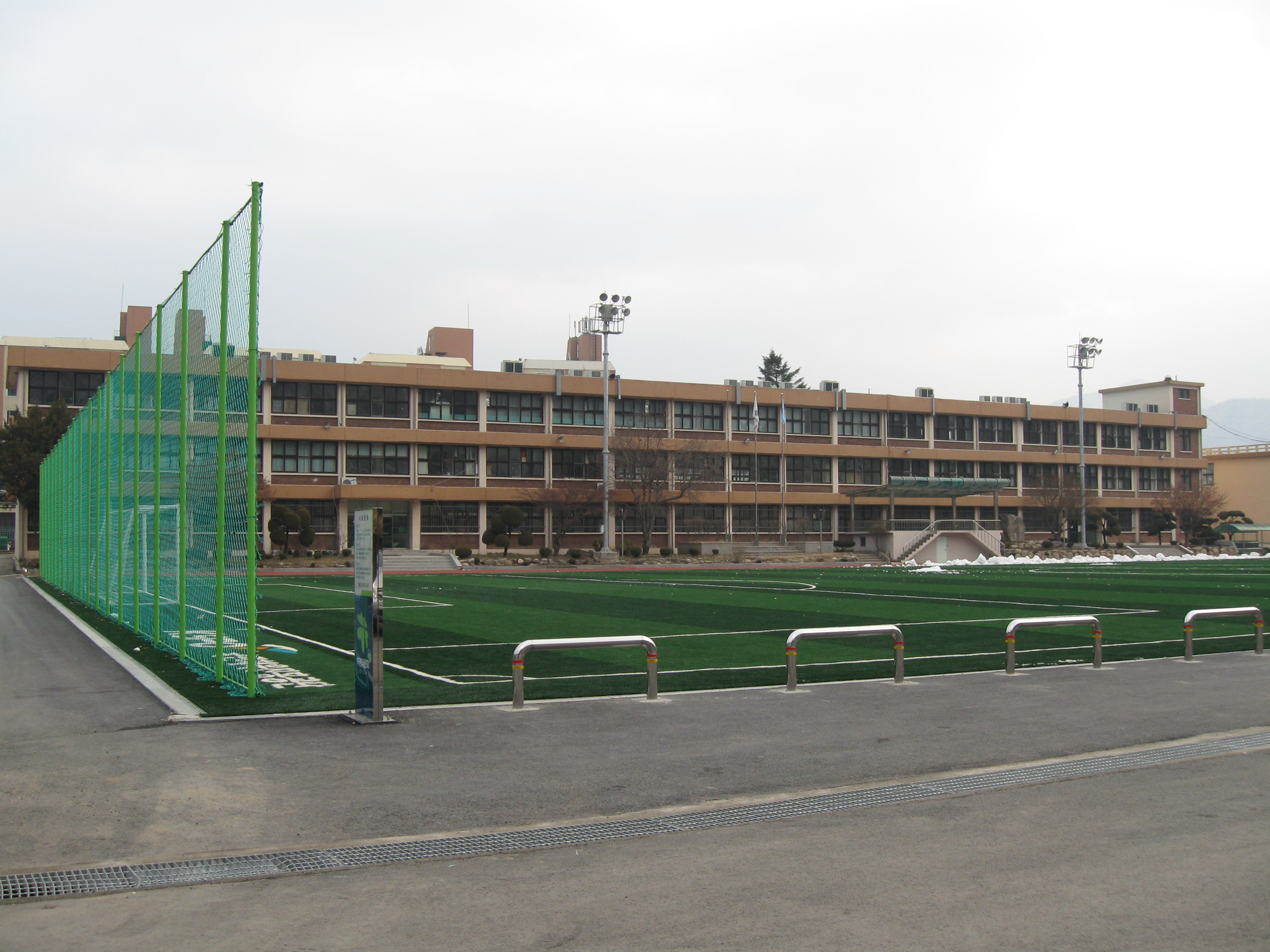
So this is the technical high school where I work, with a total student body of 300.

It actually has a much larger footprint than the last school, where I had 600 grade 1 students, (10th graders) so that was six times as many students on less property.

As you can see, it has a brand new astro-turf playing field.  The school’s soccer team is a major contender in Korea’s intramural sports program, as is their rowing team.  The students here hope they can enter the Olympics one day.  The last school didn’t have any intramural sports or any social activities for their students:  only lots and lots of test prep classes.  A new gymnasium is currently under construction behind the school as well.  And, I guess, the school does very well in a national Architecture competition at the end of April every year.  (though design is not taught here – maybe it is a 3D rendering competition)

There are only 2 Korean English teachers here, my co-teachers, Miss Lee and Miss Yu.

One thing I never get used to is the English [romanization] spelling of Korean — especially names.  Many names, especially the last/surname/family name, are spelled with the older romanization system, and most common words and many first names are spelled with the newer romanization system.  So I never know which one to use.

I asked for the names of all the students, and it was given to me in an excel spreadsheet.  So, for each class I had to figure out which students were in each class by having them all write their name on a card.  Then, I had to check their names against the spreadsheet, and for practice I wrote each name out in hanguel and for my own benefit, I romanized them.   But names kept popping up that would look wrong when I romanized them, and later conversations with the students trying to find their names on my list confirmed that.  It seems all the kids’ spell their given (first) names with the new system.  But their last names are spelled with the old system!  So confusing…

For example, my co-teachers:  Miss Lee.  Her name is spelled 이 which is pronounced like a long ‘e’, and spelled phonetically in Korean as it’s pronounced. But Romanized, it’s Lee.  Where the hell did the ‘L’ come from?  And the typical name Park.  It’s spelled ㅂㅏㄱ (bak)  The “b” is often pronounced somewhere in-between a “b” and a “p” sound, but where the hell did the ‘r’ come from?

My name is Suh, Yung Sook.  That’s under the old system.  Under the new system, is would be spelled Seo, Yeong Sook.  But if I had a student with the same name, it might be spelled Suh, Yeong Sook.  See how confusing it is?  I guess it just doesn’t matter to Koreans, because in hanguel, it’s always the same! ha ha ha!

I think there were 13 Korean English teachers at the last school.

My two new co-teachers both warned me that the students didn’t care about English and were often rude.  Actually, I find the students absolutely delightful.  They all shout out “HI!!!!!” or “Hello!!!!” as they pass.  They’re very open and friendly.  And really very attentive, considering their English level is very low.  I keep commenting on how great they are, and the two teachers look at me in amazement and say, “really???”  One has only taught two years and the other has only taught one year, and it’s only been at this school, so this is all they’ve known professionally.  The class sizes here run from 8 to 32, so having 10 less students in their largest class makes a HUGE difference in classroom management.  HUGE.  They are going to be soooo appalled when they get to an urban school……………

I had already decided that I’d establish my authority (wherever I ended up) from day one, and so prepared a system for assigning seats should I need it, as well as a behavior contract that all the students must sign, which I keep on file for the parents, along with an explanation of my expectations and rules.  I also told them that they all have B’s if they participate, and that the grade will work on a demerit system.  And A’s are for anyone who demonstrates progress.  (it’s sooo wonderful to be able to grade)  My co-teacher failed to mention that the school already has a policy about cell phones, so I probably looked like an ass over that.  (there was no policy at the last school and students were texting any old time they wanted to, which was all the time)

Then, I gave my lecture about why they should learn English to all the students, after which I had to figure out how to create a different curriculum for each grade.  So I made up three different lessons, and after teaching a grade 2 class, I was taken aside and criticized for making the lesson too difficult.  So I taught another grade 2 class, and the lesson was clearly accessible by all the students.  After a week of these critiques by Miss Yu, I got really frustrated and asked just WHAT was the student’s levels?  It took a lot of painful dialogue to figure out that the classes for each grade had been divided up into two levels:  low and high, and that they’d (sort of) barely mentioned it when I was interviewing with them, but they had never bothered to show me which classes where low and which classes were high.  After some more experimenting, failing, and getting critiqued, I finally figured out that the grade 3 (seniors) low level class was lower than the grade 1 (sophomore) low level class.  That the grade 1 low level class was higher than the grade 2 high level class, and that the grade 3 high level class was higher than the grade 1 high level class.  Confusing, right?  So I bagged the grade levels altogether and now only teach by English levels, and my calendar is this confusing color-coded matrix.

All of which is a crazy amount of work, since I only taught one grade one class, and the classes were mixed with three different levels.  So at the former school, I tended to speak to the high level students, teach to the mid level students, and the low level students had already tuned me out anyway, so it was pointless to teach them at all.  Sad, but you can’t teach a sleeping person and if you wake them up they hijack your class and nobody gets taught anything…

But here, I have to develop 3 levels of classes.  To complicate things, grade 1 gets seen by me twice a week, low level and high level.  So that’s 5 classes I have to prep for.  To further complicate things, I give the entire school a 10 minute morning broadcast four days a week, for which I am given an hour prep for each broadcast.  But the broadcasts actually take me almost two hours each to prep for.  So I’m totally swamped and take my work home with me and I’m lucky if I get an hour or two away from lesson-planning each day.

Grade 2 Architecture class just gave me shit from minute one and refused to sign the contract.  The following week the co-teacher was chatting with them and cajoling them and debating with them about why they should participate, and I was just standing there getting really pissed off, as the students had hijacked authority from the co-teacher and her coddling them had taken up half of the class time and they were now a week behind.  Afterward, the teacher told me I had ignored one of the students on the first day and that made him angry.  She said the students need lots of praise and attention.  Um, what about the other 270 students in the school?  I didn’t praise them (I hadn’t asked anyone to DO anything yet, so what was there to praise?) and they didn’t give me grief, did they?  Turns out this class had previously whipped this teacher into submission and this class had also previously given the last foreign teacher bloody hell, so her strategy for the current year was to be their buddy and let them drive.  Which I wasn’t having any part of, since they were of course essentially eliminating English from their curriculum.  Anyway, I wrote a personal letter to the other co-teacher about the situation and it got better.  I don’t know if anything was said or not, I just know it got better.  And, I gave a lesson that really engaged the students so maybe they realized it was a little harsh treating me like crap when they hadn’t even given me a chance.  I think a few of the students felt bad, because some of them would say “hi!” between classes, and one girl told me she really liked my class, and that I was beautiful and she loved me…

So, I don’t think the Architecture class is going to continue being a problem.  Yayy!

BUT all in all, the co-teachers I have are AMAZING and FANTASTIC!  They step up and translate when it’s needed.  They elaborate on things I say so the kids understand it.  They are interested in and recognize the importance of culture as a component of communication.  They really like my teaching style, even though it means more work for them. Hell, I really like my teaching style too, even though it means more work for me.

And, I REALLY LIKE the students!  And the school culture!  It’s more like a big family here.  I like them because they’re more like me, have the same values I mean, if that makes sense.  They recognize b.s. when they see it, they’re very real and down-to-earth, they’re not willing to sacrifice who they really are to get ahead, they like their lives in the country, and it shows in the spring in their step and the smiles on their faces.  They make me smile all the time.  I find myself patting them affectionately on the head, or laughing at their mischief, or totally getting where they’re coming from if they act up, and totally feel for them when they’re getting yelled at.  And in a weird way, they are much more adult about their English classes than the students at Baekyoung were.  The class is a treat to them and not just an opportunity to not study.  The native English teacher is interesting and not just a toy to abuse.  They actually listen.  Some even take notes.  Some of the rougher and tougher kids even talk a lot in English, as if they’re making light of it, but actually they’re interested in it, you can tell.

The students here have it pretty good.  The school is clean and bright.  Nobody’s beating them.  The rules are pretty clear.  Everybody knows everybody.  There’s less stress and worry in the air.  The boys’ hair is too long, and nobody cares.  The girls are allowed to wear pants too, if they want, and about half do.  And they’re not covered in make-up and constantly looking at themselves in mirrors.  The cool kids all peg their pants.  The boys have to remember to take out their piercings when they get to school.  The students are all about after-school activities as much as school activities.  It’s just more like an American high school with American high school students in a lot of ways.

And, I learned a lot during my year of hell last year.  I learned I talked too much.  I learned I did more that interested me than what interested them.  I learned more about Korean culture.  So this year, I’m more able to give them what they need.

This year, I’ve got a sort of loose formula I work around.  My goals, that I don’t always meet, include:  a new bit of slang or a new useful expression, some phonology practice, some cultural point, and dialogue practices that are ONLY relevant to them personally or in the near future.  I’m teaching much more of a survival English than an academic English, because talking should come first before reading and writing, and we need to get them to talk, and not six years after they already know 2,000 words.  So right now I’m getting them to think about what they are doing each and every minute of the day, and to ask themselves, what am I doing in English? and to talk to themselves in English.  And I’ve asked the high level students to start journaling.  Um, I also tried to introduce a collaborative project with students in another country, but the interest in that seems mixed.  We’ll see…And, I can’t be more thankful for all the intense translation I get from my co-teachers, because with that I can explain in detail my intentions and thought process and empathy for the students, so they are all fully aware that I’m working hard to make the whole process easier for them.  I can also, through translation, explain my own difficulties with Korean and how language learning difficulties are universal.  I am trying to be, for them, Mrs. Kim. 

This is a doll.  doll.  That is a suitcase.  That is a table.  The suitcase is on the table.  This.  That. This.  That.  Doll.  Suitcase.  I put the doll in the suitcase. in.  out.  in.  out. (as I’m putting the scary molar baby puppet doll in and out of the wooden suitcase) I cover the doll with a blanket.  blanket.  The doll is under the blanket.  The blanket is on top of the doll. Where is the doll?  Where is the blanket?  Where is the suitcase?

This is me.  I wake up.  wake up.  I look at the alarm clock.  alarm clock.  I sit up.  sit up.  I get out of bed.   get out of. (images of me with naration)  Dan wakes up.  He looks at the alarm clock.  He sits up.  He gets out of bed.   (images from a story with captions)  I wake up.  I look at the alarm clock. I sit up…(images with captions)  And then, just images with no captions, students saying them on their own.

It’s a really winning scenario.  I’m going to like it here, and I hope all the class prep I’m doing now will mean I can relax a little more next year.
Country life

Since I’m in a little town, it doesn’t seem THAT country to me.  But still…

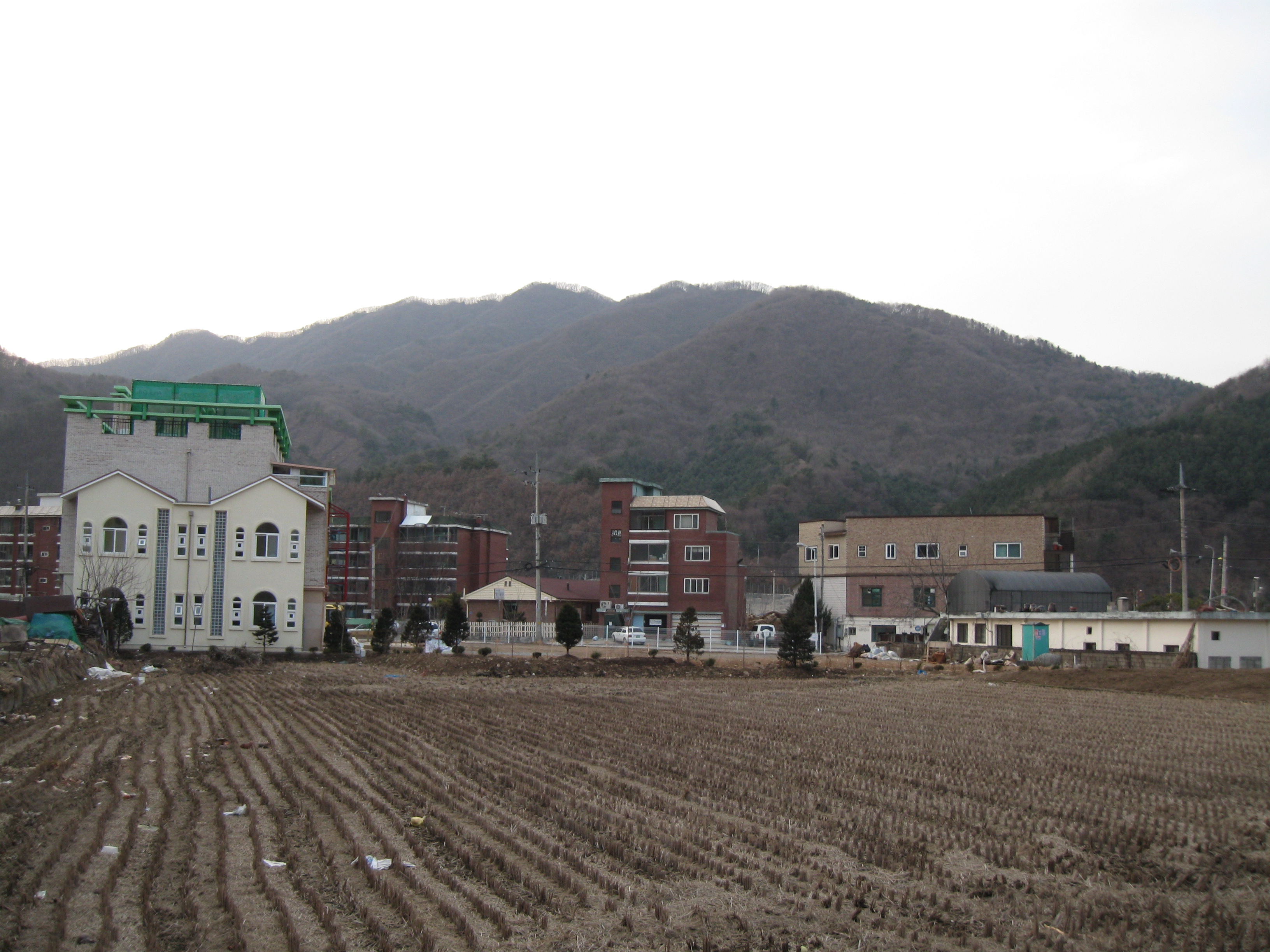
In between a lot of buildings are little rice paddies.  (quite a lot of junk has blown in amongst the dried out stalks of last year’s harvest, though, making the area look a little depressed)  I hear this area is famous for its grapes.  Since 90% of the students here won’t be going on to college, I asked what kind of jobs they can get in the area, and many of them will probably go and pick grapes, it turns out.

Because the weather has been on-again off-again still winter, the crops are a little late going in.  Some of the little fields around here have been tilled already: waiting waiting for the last freeze.  As I was walking around one Saturday looking for something to eat, I saw on two separate occasions long folding banquet tables laid out with snacks and women serving makkolli to lines of men.  I’m guessing maybe they were work crews to till each other’s fields?

On Tuesdays and Saturdays (and maybe other days?) one of the side streets is blocked off for a street market.  I think there is a lot of selling going on.  The clothing and other household goods, not so much.  But the food?  Yeah.  One thing I hadn’t noticed at the other traditional markets I’ve been to in Seoul that I see here are big square blocks of fermented soybeans.  They’re about 11″ square and about 5″ thick.  and have a gray blush of mold on them in some places.  I don’t know if they are starters for your own clay jar of soy bean paste, or if you cut off the solids and eat them like cheese or what you do with them.  There is one supermarket in town, which has the same name as the bank Nonghyup.  It’s not that interesting, so I’ll try and support some of the small mom & pop places whenever I can.  But mostly, since I eat at school and there’s not much western food and I don’t really have the time to cook, I just buy fruit, salad, and toast to snack on.  All over Korea, though, everyone is accustomed to eating imported fruits out of season.  But the vegetables, most of them are local and traditional fare.

Once in awhile I see something that reminds me I’m having a cultural experience.  Like the guy I saw walking down the hill past my apartment, with a huge stack of wood strapped to his back.  Just like those free-standing wooden cradles that men of old strapped to their backs like back-packs, this guy was doing the same.  Only I don’t think the cradle was made of wood.  Maybe a modern-day metal version of the same thing?

And the grandmas who lay out a tarp and sell things here in the country – you can tell these are excess produce from their own winter garden.  Unlike the grandmas who sell things in the city, who often have one product they have sourced and re-sell.

People here, in general, dress for comfort and it’s rare to see someone in stiletto heels and ten tons of make-up, so that’s a really welcome change for me.

The bike shops, too, sell a lot of ATV’s and the used ones have REALLY been used.  And the guys.  I’ve seen some pretty handsome guys here.  Especially the bike gang I passed in Gapyoung.  My midwest 70’s upbringing heart skipped a beat when I saw that.  I wonder if they’re just a club of guys who know they look good in riding gear, or if they are truly thugs and/or organized crime?  Ha ha ha, well I’ll never find out I suppose.

I do miss good coffee, though.

There’s one donut/sandwich coffee shop that pulls espresso, and it’s o-k.  There is, also, at least one (that I noticed thus far) coffee shop.  It was explained to me that these coffee shops are actually low budget sort-of hostess bars and that only old men frequent them.  They’re from some tea-house tradition that’s been going on for centuries, and it’s run downhill and nobody young would be caught dead going there.

Time to run out and find food again.  I need to plan /shop for weekend eating better.

Fresh air from China

Last weekend I could barely see the mountains. I mean, it was really bizarre.  The sky looked sepia…

I asked someone about it, and they said that it was the yellow dust from China.

Before, when I’d been told there was yellow dust and that it came from the deserts, I was a little skeptical and confused and also it didn’t seem that bad and I just wondered if it was hyped up health hysteria here.  The sky never looked that bad to me, even when half the people were donning the face masks.

So a couple days later I got the internet and turned on CNN.  Sure enough, winds from the Gobi desert had picked up huge amounts of sand and, after blowing across China had also picked up all the auto and factory pollutants.  Residents of Hong Kong were advised to stay indoors and the pollution had been measured at 10 times worse than normal.  And, the visibility was something like 6 times worse than a bad day in LA.

I now take yellow dust very seriously.  Maybe I should go buy a cute face mask.  There’s an endless variety of designs to choose from…

But this foreigner never really knows what the weather’s going to bring.  Every once in awhile, if something really exceptional is about to happen, someone might remember to warn me about it.  But mostly, the forecast is me sticking my head out the window because weather just isn’t on my mind.

Yesterday, walking home, it was snowing in flurries.  I texted Joyce and it wasn’t snowing in Anyang.  It’s almost April, and it’s still snowing in the mountains!

Still hungry in Korea

For half a week I didn’t have a refrigerator and had to just live off of convenience store food and wander around searching for restaurants.  One morning I was starving because I hadn’t had enough to eat the previous day, so I left early and managed to find an open restaurant.

Koreans eat huge breakfasts in their homes that consist mainly of soup, rice, and left-overs from dinner.  There really isn’t much of a distinction between breakfast foods, lunch foods, and dinner foods.  The only restaurants that are open in the mornings are for those that have stayed up all night drinking, and those primarily serve two soups:  haejangguk and kongnammul.  Kongnammul is bean-sprout soup, and it’s really yummy.  Haejangguk is more like collard greens soup (I don’t know what kind of green is in it:  maybe it’s spinach?)

Haejangguk was the only thing on the menu, so I had to order that.  Only this haejangguk had a huge chunk of gray, nasty-tasting liver-like flavored grossness floating in it.  I told Jane about this later, and she told me it was blood.  NOT what I’d want to eat after a night of drinking, that’s for sure.

I went to another restaurant for dinner.  I still don’t know what these dishes are – there are so many of them, and I only know the cheap shitty garbage ones that single people are allowed to order, and that gets really boring after awhile.  It’s really sad to go somewhere and be surrounded by groups of people at tables groaning with an amazing assortment of delicious-looking food and be told you can’t order any of it.  I had a mild case of bronchitis and thought samgyaetang (sp? that ginseng-stuffed chicken soup) would be good for me and got excited to see a place that served it.  I was a little disappointed to see the woman cut open a pre-packaged stuffed chicken soup bag and just dump it into a pan.  But she sat down with me and was teaching me Korean words and taking an interest in me like Mrs. Kim.  She even offered me some of her Kim Chi Chiggae, which was chock full of lots of beef, but I declined.

A few days later, I went back and asked for Kim Chi Chiggae, and she said obpsoyyo (sp?) which means, “NO.  We don’t have any.  Forget about it.”  In my baby Korean I asked, Kim Chi Chiggae, o-di?  Odi means, “where is?”  (so that’s totally spelled wrong and it’s grammatically wrong, but what else can a person do?)  She pointed to another restaurant and I went there.

Only I didn’t see any 김치 (kim chi   ㄱ=k  ㅣ=i  ㅁ=m     ㅊ=ch  ㅣ=i  ) anywhere on their menu and instead somehow managed to mime to the waitress that I’d like whatever she liked/recommended.  She brought me some soup that looked super yummy.  It was some milky, beefy broth with noodles in the bottom with slices of what looked like beef brisket  spread across the top, like the photo hanging on the wall.  Only the beef in my bowl was just surrounded with fat.

I fished out a slice and tried to cut off the fat with my chopsticks.  (yeah, this is how you cut in Korea – you perforate the food with your chopsticks and then insert both sticks in at one point and S-P-R-E-A-D your chopsticks apart and hope and pray you don’t flip the food across the table) The wait staff was very amused by my pickiness.  A lot of the cuts of meat in Korea are through layers of fat, and sliced across the layers.  It’s customary to just eat the meat, fat, and all.  And I always cut it off.

I’m already the slowest eater in Korea, but this is just too much.  Korean etiquette demands that nobody leaves anyone alone at the table, so they hate eating with me because they have to wait long after they’ve finished eating before they can leave.  I tell them, “it’s okay to leave!  I want to eat slowly.  I’ll be ok!”  And then they all thank me profusely with relief…

But this meat – even the meat texture seemed strangely squishy and the fat even seemed strangely squishy.  The waitress, who could speak a little English, asked me if I didn’t like meat, and I tried to show her it was just the fat I didn’t like, as I pushed it with my chopstick.  So much fat!  As I pushed pile after pile of it to illustrate what was offending me.  “Oh!  jelly!  You don’t like jelly!”  I was a little confused, and I asked her, by squeezing different parts of my body, where this meat was from on the cow.  She said, “cow head.”  Cow HEAD?  “Nae. (yes)  Cow head.”  Oh!  The jelly made perfect sense then.  So that is how Suki came to eat cow head.   I returned the following week and just asked for Kim Chi Chiggae, and it was that simple.  They were really pleased that I didn’t pick anything out and I could hear them saying what must have been “at least she likes the kim chi chiggae.”

The school lunch is pretty good.  At the last school, teachers had their own cafeteria and got good food, while the kids got mystery meat and truly disgusting food.  At this school, the principal, teachers and students sit together and we all eat the same thing, and it’s almost as good as the special food prepared for the teachers at the last place.  The food is ladled for you, except rice is all-you-can-eat.  It’s really confusing to me, because the skinny kids and the fat kids all appear to eat the same amount of food.  After a week, I discovered I could also eat dinner at school.  Staying an extra hour and a half to eat dinner sounded depressing, and at first I declined.  But it turns out I am so swamped writing lesson plans I am spending each night working at home on school work anyway, and at 2,500 won (a little over two bucks) a meal, it would be stupid of me to not eat dinners at school and, it’s yet another way to bond with the students and faculty, who I’m sure are envious of the foreign teacher for getting to leave earlier than everyone else.

I had finally started eating a regular breakfast before moving here, and after getting the refrigerator I started up again.  Only in the course of one week eating both breakfast at home, and then lunch and dinner at school, I noticed all my clothes getting tight.  So I’ve cut back on breakfast.  I also take hardly any rice and don’t eat all my noodles.  Except for the fatty cuts of meat, Korean cuisine is really low-calorie and has twice as many vegetables as western cuisine, and the quantity of meat is a lot smaller.  But in addition to twice as many vegetables is four times as much starch.  And most of the beverages are heavily sweetened.  So I think to not blow up I just have to avoid starches and sweets.  Sounds easy – but here, it takes a concerted effort.  The salt?  That’s just impossible to avoid.  They sell it in huge bags, and there are all manners of varieties of salt.

Water with meals is not something Koreans really drink much of.  It’s mostly used as a mouth rinse after eating.  All the vegetable fibers and pepper flakes get stuck in your teeth, and the post eating rinse helps with the most superficial remnants.  There’s also almost always a mirror and everyone will file past, checking to make sure they don’t visibly have something unattractive stuck in their teeth.  After which, everyone rushes to their toothbrushes and brush furiously.

At the last place, I didn’t brush much because I’m still of the western mind-set that brushing is a private practice.  And I also felt harassed at Baekyoung, with everyone constantly watching everything I do and analyzing me and criticizing me.  I just didn’t feel up to having yet one more process scrutinized.  Here, starting fresh, I just brush in public too.  Only I do it to for practical reasons and not as a group socializing thing, and it’s never questioned.  If I miss one time, Young-a is not there to scold me.

Which reminds me – Korean toothpicks are awesome!  At first, I thought they were plastic.  But then I noticed the back-up box they came in, and the packaging said, “starch tooth pick” on it.  That’s right:  they’re basically super hard noodles!  They don’t break off like wooden toothpicks.  They don’t break down into fibers that also get stuck in your teeth.  They keep a needle-sharp point, and they don’t get soggy if you want to chew on one for a long time.  And they’re also a very green product.  The whole world should use Korean toothpicks!

The other day I took Dongja out for dinner, to thank her for all her help and had her pick out a place.  (she has constantly been fielding phone calls from delivery men and intervening on my behalf and arranging things for me and taking care of me)  I always get excited to eat out with another person, as a single person can only order 1/10th of the menus and I, therefore, haven’t been able to truly experience much Korean cuisine.  We went to a restaurant and ordered pork lettuce wraps.  The pork was braised, and the same cut used to make bacon, and spread over a bed of sauteed onion crescents.  Again, I had to cut all the fat off.  The wraps were sesame leaves, (known as perilla leaves in Japanese sushi restaurants) mustard leaves, and red leaf lettuce.  It was served with a sizzling clay pot of dwengjang (fermented soy beans) that had been stewed with jalapeno peppers and mud snails(?) and which you can also mix into your rice.

It seems side dishes are often added onto your rice and mixed in.  If the side is large enough, or if it is a piece of dried seaweed, it is lain on top of the rice.  The chopsticks are spread about an inch apart, and pushed down at the same time.  In this way, you’ve formed a bite-sized package that you then squeeze together and pull off to drop into your mouth.

Shrimp sauce is added by the spoonful into soups to make them salty.  And soy sauce with hot peppers and green onions can be added to make dishes spicier.  I’ve seen ground nuts as a condiment for certain soups as well.  The squeeze bottles of Gochang (red pepper sauce) are usually mostly for bi-bim-bop (mixed rice dishes)

Koreans often take spoonfuls of white steamed rice and dip them into their soups to flavor the rice.  Near the end of the meal, they often take all of the remaining rice and spoon it all into the remaining soup and eat it like a stew.

They usually start with the still boiling soup and alternate between the soup, main dish, rice, and side dishes.  They think I’m weird because I typically eat one thing at a time.  Part of this is because if I find a good thing, I like to stay there, and because finding a place to lay down and pick up my chopsticks repeatedly is awkward.  I also believe it’s healthier to let your digestive juices work full strength as long as possible, so I eat my soup last.

It was really, really good.  The meat you’re supposed to dip in this light sauce, which looked to be soy sauce with jalapeno peppers yet tasted like it also had a little horse radish in it.  There was also a side dish I really liked that consisted of Spinach, sesame seeds, and what Donja said was a two-headed snail (?)  There were about six side dishes in all.  And all very yummy.  Cost per person was 8,000 won, which was about 50% less what it would have cost in Seoul.