One mother’s joy is another mother’s pain. Period.
Meatless in Korea
An adoptee friend of mine recently wrote an essay at the highly caffeinated Land of Gazillion Adoptees website. You know, that one started by the Korean adoptee Kevin Ost Vollmers, who once worked for the adoption industry and then got so disgusted by what he saw there that he’s turned into one of the most outspoken anti-adoption critics ever? Anyway, this essay, Meat Market , has gotten a lot of press amongst us Asians and Adoptees, and I wanted to share it with you.
What struck me first by this essay, and which continued to plague me, was the title. How could something so significant be marginalized to the lowest degree like that? Sure, it’s fleeting and all, but to consider your fellow brothers and sisters in adversity nothing more than meat??? But then I realized it is self-reflective, because the adoptee community here is our first reflection of ourselves, and we have deeply been ingrained all our lives to marginalize ourselves because we didn’t reflect the rest of society where we were raised.
It’s so beautifully written, you just ache when reading it. And every bit of it is accurate too. It’s bitter-sweet and ironic for me in that here I live in the same place yet live in a society imposed celibacy. Like the other adoptees, I suffer romantically from being a Korean who can’t speak Korean and being a foreigner who doesn’t look foreign – whatever I have to share is incommunicable, and whatever I can’t communicate is not exotic enough. It doesn’t matter if you’re Korean or a foreigner – one of those will make me all wrong every time. And unlike them I don’t have other adoptees to turn to, because I’m two decades older than most of them. But as you can see by this essay, that’s not necessarily a bad thing. I wouldn’t want to turn to them – even if they did desire my company – even if I acknowledge what a relief it is to dip my foot in the relaxing water of not having to explain what I am. It’s like another version of Looking for Mr. Goodbar. We grope in the dark. We obsess over our scars. Like infants we try to absorb some meaning through orifices. And with each hollow disappointing encounter, continue the myth/quest that knowledge can be passed on this way, or relationship can be encapsulated. I know this because I looked for Mr. Goodbar long before I should have.
I’ve always questioned just what is meant by adoptee community here. Sometimes I think it means any number above 1. It certainly doesn’t mean participation. It certainly doesn’t mean agreement on politics. From my observations, it has more to do with the elation you feel when you discover you’re not the only one. And it’s a euphoric feeling when you find you can be part of a group that you have instant membership to, and such a relief to not have to explain what you are. But that relief is short lived. It’s like taking a barbiturate: it’s addictive, and its intoxication is soon replaced by depression. What attracted you to them in the first place was that they are just like you. And then you realize once you get to know them: omg, they are so messed up, and they ‘re just like me? You want to embrace them in all ways, and then (I imagine) the embrace becomes disturbing, as if you just slept with a clone of yourself. And maybe that loathing you’re experiencing is really self-loathing. How many mirrors can one person stand? What is it like to live in the fun house when you can’t leave and it’s all you’ve got?
Yes. I’m certainly glad I did not come here in my twenties, an age when people have a hard enough time sorting themselves out amongst all they’ve known, much less through dislocation. They are brave souls and it’s psychically dangerous. But you know, what doesn’t kill you…
compulsion
I never used to write, you know.
It started with a little adventure I went on a few years ago – so adventurous it had to be documented. But since I can’t write just to indulge my own ego, I wrote it with my daughter as an audience, so she could share the journey with me. And record I did. So much so that she was shocked in places. I had to apologize to her – I just couldn’t stop, once that damn was open.
Blogging has been like that. I never in a million years thought I’d be sharing my thoughts with people I’ve never met for over three years.
Reform and activism is like that as well. I’m spending my vacation and the remainder of my stay in Korea putting my back to fixing things.
These things are like compulsions. Once they start, they become a way of being. I CAN’T not write now. I CAN’T not try to meddle with the machine. Well, I’ve always been that way, actually, but that energy hasn’t been harnessed well. I think it’s getting more focused and finer-tuned all the time. I think we do get better as we age.
What’s interesting to me is some people are so intentional about this stuff. They think, “I will blog and I will become famous.” Or ” I will be an activist and try to get my photo in every newspaper.” They are like career narcissists, these publicity hogs. And then there are those that get all proud of a limited engagement of self disclosure or charitable act and want to think of themselves as heroes. Pfft! As if aggrandized self-esteem could ever make that meaningful. And though I love David Bowie, I always hated, “We can be heroes, just for one day.” No. Hero comes from afar, not from oneself. And it’s a way of being that you can’t shut off.
And I know this because I have met people like this man:
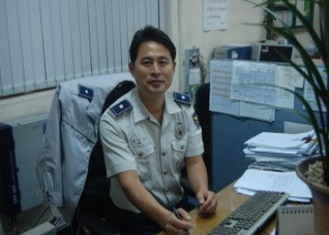
Sgt. Lee is also compelled. He just . can’t . stop. Many days he puts in 16 hours. He works every day. Even his studies are all in support of reuniting families. Last night I told him he was a hero to many adoptees, but of course heroes don’t think of themselves that way: they just do what they have to do: what humanity compels them to.
And I am compelled to do more than just sing his praises, but to give him some relief from the relentless tidal wave of separated people that press him into service every day of the week. To garner support for him, resources, and assistance. Because it is a compulsion, I too don’t feel like I’m doing anything heroic in advocating for this man. I just can’t forget about what he does for us. I can’t just push that idea, that he does this all by himself and suffers, out of my head. It’s just a calling and something I have to do.
And it’s such a no-brainer. Do you put your resources into a bitter argument that is political suicide, or do you put your resources into something that has proven success, that is a worthwhile investment, that is immediately actionable, that builds a stronger society? Things like that are beyond politics. More and more these actionable items regarding healing Korea and cleaning up this mess pop out at me with increasingly glaring clarity. I’m sick of talk about adoption. Sick sick sick of adopters and adoptees and this ethics or that morality or cries of corruption or cries for justice or rectifying history or demanding restitution or any and all of anything debatable surrounding this topic that everyone has to weigh in on but nobody can get beyond.
We need to listen to our hearts more, and learn to tend our compulsions into productive gardens. It’s so rewarding, and makes me so happy.
Two less eyes?
For those of you considering laser eye surgery in Korea, I wanted to add yet another blog post about it, if only to save you some of the hours and hours of research me and my friend have done.
The thing about laser eye surgery is that there are ten billion options to study. Previously, I had determined that I didn’t want it because those custom intraoccular contact lenses (ICL) or the hard lesnes that you sleep in that correct your vision are safer. However, I realized that I’d be really lame about putting them in and taking them out, so it doesn’t honestly fit with who I am. But the ICL is great – no cornea damage, can easily be corrected if the prescription changes, and the best of all the methods for improving vision. Unfortunately, I found out that the ICL is about $3,000 PER EYE in the U.S. and about $2,000 PER EYE here. So if I want to surgically correct my eyes, then I have to go with the lasik or lasek.
Lasik and lasEk are a huge huge business here. The doctors get their training mostly in the states and you can pretty much trust that you’re in great hands just because they get soooo much practice. The prices are anywhere from $900-2,000 US for BOTH eyes, depending on what your needs/wants are. LasEk is more conservative as it only carves (ablates/ablation) the top of your cornea, but the healing process takes 3-5 days and it takes longer (up to a month) for your vision to normalize. Lasik is pretty painless and has a 1 day recovery time, but it slices a flap on your cornea so you have to have thick enough corneas to do it and with blunt trauma it can rupture. (but the odds of that are like really small unless you are into sports) And (euww) the flap is also visible in the right light. LasEk used to give better results, as the cover (epithelium) over the cornea regenerates but the Lasik flap is more like a lid from then on, and Lasik has been associated with more dry eyes and night vision haloing, but now they have better technology so if (and only if) you are using the latest bladeless (intralase) laser machines, then Lasik is actually the most seamless way (pain, recovery, visual acuity) to go. However, Lasik is also a little more expensive here in Korea. Most Koreans opt for Lasik unless their corneas are too thin, but most of the westerners are opting for LasEk because it is more conservative with cornea material. Some places use the bladeless (intralase) laser machines for LasEk, but have read that the bladed (excimer) laser machines perform equally well.
Another consideration is the machinery being used. Clinics will market their wavefront technology, and/or people on boards will proudly talk about how they opted to pay more for wavefront, but actually it’s pretty much the industry standard now (at least in Korea) and the optician selling you wavefront will call it, “custom.” In my layperson’s estimation it just means that the computer is mapping the topography of your eye and custom adjusting the correction to match. The majority of options will be on the custom end with higher prices, and the few options with an amazingly cheap price will be from older machines which don’t use the wavefront technology. One comparison I found of machines was this spreadsheet. I found it very helpful to look at the equipment being advertised at each clinic to see which place had the best, and in my opinion I used frequency of pulse and speed of tracking as indicators of how accurate the end results would be.
And of course, the most important consideration is the judgement of the ophthalmologist! All the latest technology in the world is no good if the doctor has poor deductive reasoning, little experience, or puts profits above your eye health.
The problem is there are soooo many clinics, it’s hard to choose. So my friend went to four different places and I went to two of them with her.
The first place we went to, rabidly recommended by her colleagues to the point it was an obligation to go there, was Bright Eye Clinic (서울 강남 밝은 안과). It was very well appointed and on the upper end as far as prices went (in the 1.8 million won range even after their400,000 won Christmas special) It was a little disconcerting how assembly-line it was going through all the diagnostic tests, but it turns out that all the places do this, and since most of the measurements are machine-generated and simply recorded by the staff, and since the decisions will be made by the ophthalmologist, then I’m willing (and forced by default) to accept that in the interest of efficiency and lower cost. They told me I was a candidate for either surgery, though they kept pushing the Lasik on both of us. And both of us were increasingly disturbed by how patronizing the optician/sales person was of our leaning towards LasEk and how dismissive she was of any concerns we expressed whenever she pushed Lasik on us, telling us things that directly contradicted everything we’d researched on the difference between the two operations and discounting any of the risks. Later, after comparing their machinery against some other clinics I realized they had one of the latest bladeless lasers (IFS Crystal Plus brand) which they probably paid a pretty penny for, and which they were seeming to push on everyone as it was their premium service for the highest price…While it is true the bladeless is a significant improvement of Lasik, it also seemed irrelevant since we weren’t interested in Lasik. The hard sell left us feeling really alienated and questioning whether they really had our best interests at heart.
And so my friend continued to shop around for another opinion, especially because she was recovering from an eye infection due to scratching of her cornea by contact lenses. She was going to go to a place recommended by a colleague who used to work there, called Our Bright Clinic (밝은우리안과). But she couldn’t line up an appointment with them and I didn’t like how they had a limited selection of laser machines that were a little out-dated, though it sounded like from her colleague’s description the doctor was infinitely experienced and conservative about eye health. So then she went to Bright Hospital who she said had fabulous manners, explained everything really well, and were very forthcoming about everything and conservative about her eye health. She was really blown away by everything about them, but they were also very expensive (2.2 million won) and didn’t have any holiday internet specials. And, if that wasn’t enough mind-warping dilation drops for one week, she also went to Dream Eye Center Gangnam (드림성모안과), well recommended by foreigners for being accommodating to English speakers. It lived up to its reputation, but she felt most confident about Bright Hospital.
So there we were, three high-end eye clinics – one best for Lasik, one excelling at professionalism, and one comforting for foreigners.
After combing through all the expat forums I found one doctor on-line who does lasek for about 1.5 million won for both eyes which, after their Christmas special meant their best LasEk procedure would be 1.1 million won. My friend asked her Korean friends to investigate the place, as charging 500,00o won less than most other places can make one a little curious as to why and how. It turns out that the head doctor got kicked out of a laser eye surgery association because his prices were too low and he was making the rest of them look bad. Anyway, this doctor challenged the association to publish what their operating costs/profit margins were and they didn’t respond. So if you’re an owner of an eye clinic, he’s a villain who’s undercutting your livelihood, but on the other hand, if you’re a blue collar type person, he’s a hero championing vision freedom for the masses. And, there are half a dozen doctors who also feel the same way on staff there. I only found a couple English language reviews of the clinic and they were both very positive, and the equipment they owned was comparable to the expensive clinics, except that he didn’t have the latest bladeless laser machine. But since neither of us really wanted laSik, that wasn’t really of concern to us. Because of the price, we HAD to go check it out. It’s the one we ended up choosing.
Bright St. Mary’s (밝은성모안과)is kind of scary when you walk in because it’s a little shabby and totally packed with clients and you wonder how any place processing so many people can do a good job. But then you remember that everything’s being guided by computers and that of course it’s going to be packed if it’s half a million won less than the other guys. Just like the other places, the diagnostic tests were assembly line and my friend was a little annoyed by one especially robotic staff member. But none of that really mattered because we really felt we were in the best hands when we got to our consultations with the doctor, who spoke really good English.
For instance, he advised my friend to take a DNA test which rules out some genetic eye conditions that would render your laser surgery meaningless if your eyes would just deteriorate anyway after surgery. Only a couple places mention this, and it totally seems to me like all the other doctors who don’t offer this $100 test to people are pretty much preying on those poor folks who have the genetic disease, which seems kind of unconscionable to me. While all the other doctors told her she was a candidate for any operation and they could operate immediately, he was more cautious and wanted to wait until the scarring from her eye scratch and infection was completely healed in order to make an accurate diagnosis.
In my case, the topographic map of my eye revealed an area of the cornea that was considerably weaker/thinner than the rest and he wanted to make sure it was not due to a temporary problem and questioned whether I would really want surgery at all due to my aging eye condition (presbyopia). So he also gave me an eye drops and steroid prescription for two weeks of therapy prior to fully diagnosing my eyes. It turns out that the difference in thicknesses around my cornea were permanent, and he would in no way EVER recommend Lasik to me. Can you imagine if I’d gone to the first place and listened to that saleslady? I could have had a blow-out in my eye flap! However damning the color-coded topographic map of my corneas were, the measurement of the depth of my eye was really encouraging and it was determined that clinically, LasEk would be no problem at all. Technically, the amount of ablation (removal of material) to my cornea for the LasEk procedure would be 0.3 to 0.35 mm and my corneas were 1.8 to 1.9 mm thick. Most Korean women’s corneas are about 1.5 mm thick, so that leaves plenty of room for further correction and a safe cushion over my lenses. He was still concerned that I’d be unhappy because I’d have to wear glasses to read or use the computer, and I had to convince him that I was okay with that.
Anyway, I’m really really happy we got such a conservative doctor, one who will gladly turn a client away if it’s not in their best eye health interest, and it’s just a great bonus that, with the holiday discount and another discount, our operations cost only 900,000 won. That’s $780 dollars U.S. for BOTH eyes! Bright St. Mary’s. Highly recommended…Plus, part of their profits go to UNICEF!
By the way, my friend got her surgery last week and is recovering in the same way we’ve read about from other accounts. I go in next week, and I’ll tel you more about the recovery process a week later. I can’t wait to wake up in the morning and not have to grope for my plastic eyes. Life is going to be so beautiful…
ADDED: For the post-op write up, go to Two Less Eyes Continued
Letting things go
Copied from a document, done away from home, on my dying laptop, while my school computer gets reformatted, and quickly pasted once home again to beat the cat at its own game of killing the computer by pulling out the plug…
Sorry I haven’t written in awhile. Actually I’ve written lots, but it’s a disorganized mess and not fit to share with anyone. I’ve spent the last few weeks editing my life in preparation for returning to America, and I’m only now beginning to make order out of that chaos. (and of course Momo’s an attention hog and won’t let me access the computer more than ten minutes) Every day I stack my things into piles of keep or give-away, and then the next day I re-visit the piles and pare them down, and then rearrange or move the things to a staging area for packing or to a finished area for giving away, things which will go to the unwed moms.
I certainly have collected a lot of stuff in three years here. It seems I have a problem with attachment to things. And yet, I know that these things are not so much, comparing the quantity of what I have with my former world-traveling friends, who had houses or condos and brought back wonderful mementos from all corners of the globe. I’ve nothing so nice with my meager budget, and I’ve no home base to deposit things from my leisure travels. I’m a middle aged lady living in a position created for people still in their twenties. Me – I’ve got a wooden lamp given me by the Korean Emigration Museum for donating my adoption documents, some gomu (rubber) shin (shoes), a fan painted by nine stones’ mother, a Thai sarong hand-woven by some tribe from my visit there, and too many books on how to learn Korean. The rest of the stuff is just crap by most people’s standards. But it’s all I own, and I can’t afford to just start completely over from scratch, even though I’d love to.
The real problem I have with my relationship to stuff is wanting to always be prepared. Any lover of tools (In fact, I think part of the reason I got into Architecture was because it combined the need for precision tools and supposedly creativity) can understand this: there is a right tool for every job and there’s nothing worse than being shut down when inspired because you don’t have the right tool at hand, and to keep life stress-free there needs to be a place for those tools. This isn’t a problem if your interests are focused, but it’s a big problem when you’re interests are scattered and you’re a jack of all trades like me! It is really hard to part with tools you KNOW will satisfy a future need.
Prior to coming to Korea, I had to part with my entire art studio (we’re talking band saw, circular saw, drills, workbench, wrenches, soldering gun, alcohol burner, melting pot, oven, etc. Etc.) and it was sooo hard, sooo hard. Because all I want to do is make things, test ideas. Usually I fail, but I haven’t had the luxury or privilege of time to fail enough to learn enough for an experiment to succeed. But I was at least completely fitted out for any eventuality.
Even though I’ve only been here on an extended temporary visit, I’ve still been pretending to repatriate and, due to the isolation and hoping I’d have more company, I feathered my nest a little more than those just passing through normally do. Though on a limited budget, it’s been a comfort. It’s been a comfort to imagine the next project and to prepare for it by gathering tools.
And so I sort, and I rescue. I rescue the mini hand drill. I rescue the miniature Japanese model-maker’s swivel exacto knife. I rescue the circle cutter. I save the glue brush. I keep a jealous eye on the side-cutting nail clippers. I save the cone thread holder, and any useful thing I got here that is hard to replicate or find in America. I save my yoh mattress, because it’s cheaper to ship than to buy a new bed as soon as I get to America. I will exceed my free luggage limit by one bag even though I will be sending yet another bag with a friend the following month, and I pray that U.S. Customs will allow smart carts in the inspection line. I will look like some greedy importer, were it not for the cat carrier slung over my shoulder…
Other than that, I am trying to lose the ten pounds I’ve gained in Korea and throwing myself back into adoptee advocacy work from my desk at school. Which, by the way, I am feeling more and more confident in my position, since I tend to focus only on things which are concretely fix-able, and with collaboration are totally do-able, and we collaborators are finding each other. I’m also enjoying doing research for the book I plan to edit. With my typing hands tied down by paws at home, I watch a lot of BBC nature t.v. with Momo and am looking forward to another season of last season’s Work of Art and Project Runoway. Lasek surgery (more on that later) in a week will put everything on hold for a few days, and I’m hoping to get my hands on some Salmon Rushdie or Kipling or something else on tape that is lyrical but tells a beautiful story. My best friend here is going to by my nurse during the worst day of recovery. Unfortunately, the best treasures are people, and I can’t pack her into a bag.
I have many many reflections, but most of them circle back to where I talk about my struggles with one popular person I hurt but nobody sees the damage she did to me. That, too, is something I need to let go.
Momo had to experience a time-out to write even this little piece, so I’m going to call it a day and hopefully will be able to check back in more frequently now that I’m back at work and as soon as my computer there is repaired.
Happy New Year!
A poem by a daughter removed from her mother
Powerful images and rational arguments by an adoptee/scholar/poet on re-humanizing the women who gave birth to us.
Jennifer Kwon Dobbs was recently reunited with her birth mother from whom she was forcibly separated from, the fact of which was not reflected in her case file. Today she is happily learning her way around the Korean kitchen under the guidance of her doting Korean mom.
Jennifer pioneered unwed mother’s advocacy in Korea and works intimately with Korean Unwed Mother’s & Families Association. She is a fellow at the Korea Policy Institute.
 Hello Korea !