sigh

From an email about my mess-up at school.  Near the end was this:  (I think this was in reference to my melt-down at the restaurant last week?)

finally,

I want you feel happy to work here and work with us.

I wanted you to help you in many ways, but I couldn’t afford to do that.

I feel stressful with a lot of work and my students.

In case I can’t help you, using a Englsh-korean dictionary can be helpful.

OK. So I’m left without any attempt at socializing because

but I couldn’t afford to do that

See?  Being kind to foreigners is a financial burden!  (knocking head against wall) and the sympathy I get for not being able to communicate is

ADDED: hmm.  maybe she was referring to time and not money…

In case I can’t help you, using a Englsh-korean dictionary can be helpful

Um,…If there wasn’t a dictionary in my cell phone, I’d have killed myself by now…

This is actually (sigh) a very supportive (sigh) note.  But a lot of times our conversations feel like I am getting a lashing.

For example, when I ask a question and am anticipating some advice, I hear, “You better . . .”  I always have to check myself and remind myself that this Korean obviously doesn’t know that these words begin an admonishment or come as an order, and the intonation sounds like an admonishment or an order, even though I know that the intent was (hopefully) kind.  I tell the students that English sounds harsh, and that they can soften the language by acting and putting their emotions into their words and to soften their tone, but the adults aren’t able to do this…

Some days I’m just all bloodied and black and blue, but you have to suck it up and be thankful that you heard someone speak a word you recognized.

And I’m being asked for hand-outs again.  Immersion shouldn’t be about reading freaking hand-outs.  These kids don’t need more hand-outs, which will just end up in the recycling bin anyway.  These kids need to hear a native speaker saying, “Oh, I would try doing this or that.”  Instead of, “You Better . . .”

it’s half me

It’s final mid-terms week (I say that because that’s what they call it –there’s a mid-term between school start and actual mid-terms, and then it repeats again next semester) and we work only half days.  Which comes at an awful time because I go home to my four walls and work in literal isolation, though it’s good for TRACK as I put in about 8 hours yesterday.

Between photo processing and blogging I bounce from napping to changing channels to eating too much fruit and drinking too much coffee.  And then I accidentally hit the channel where all the young beautiful foreign students are jabbering away in Korean, giving Koreans even more ammunition to belittle all of us who aren’t subsidized by mommy or their governments, who can’t pick up even basic survival words.  And my entire body is racked with the tension of a suppressed small scream and I flip back to On Style channel. (My incest therapist told me to pay attention to my body and every time I was tense.  Do you have any idea what a knot my body is here in Korea???)

Of course, there is plenty of time in this period to be cracking open the books.  But they sit there, mocking me.

It’s fatigue.  It’s walking a thousand miles to face a mountain, after having spent over four score climbing mountains. To be zapped daily with rejection to find yourself back again alone surrounded by four walls.

Who do I do this for?  My mom?  For all my (cough) Korean friends?  (they only want to speak English to me, even my one Korean friend)  Is overcoming this even worth it if all I get is this dull tool in this impenetrable culture?

It’s despair over being faced with your stolen birthright.  To fail at communicating with everyone around you reminds you how you’ve always had to walk a separate path from everyone else since the day you turned around in the market and everything you loved and knew was gone.  It’s beyond the insecurity of saying something wrong or being shy.  It’s beyond words.

Who do I do this for?  For me???

This language is the language of abandonment.  Our minds tell us we should reclaim it.  But our hearts tell us that it’s a pointless exercise, a reliving the nightmare of crying in Korean and nobody being there to answer. With every word misunderstood is an invisible beating with a blackjack.  With every word gained is a faint echo from deep inside telling Korea to go to hell.  Each. and. every. Korean. word. creates a storm of conflict in us adoptees.  What will communicating here really do for me? Except maybe have a more exquisite understanding of pain.

This hungry ghost has tape across its mouth.

country notes – or knee high by the 4th of July

…but here it is knee high by the 4th of June.

The corn growing on the slopes of the Tulli bldg. homestead next door is waist high, but at farms all over the region it is way taller than a man already.  As several of us have remarked to one another here – there is no need for “miracle gro” in Korea.  In the rice fields, the green has totally obscured the water already.  It’s crazy how bountiful the land is, this red, clay-filled soil.  With spring nearly non-existent, the growing season is really long here.  It’s already melon season and tomatoes are beginning to appear on the market shelves, thanks to the rows and rows of hot houses everywhere.

I have had Koreans tell me that they must learn English because Korea has no natural resources.  As a person who believes in local self-sufficiency, I wonder if Korea could just stop importing food and support itself, and what natural resources they think they need to be successful?  There is probably a full woodlot for every man, woman, and child in Korea in these mountains if managed properly.

What is it that determines what man needs?  I often think the measure of civilization has been turned on its head.  All over the world, honest living is now perceived as inadequate for life.  Another reason I abandon architecture, yet another contributor to the promotion of a frozen moment of perfection that is unattainable that is fed to the masses to promote consumption.  Sloppy, messy life is so much more beautiful to me.

Outside the train station halmoni’s sit and sell steamed corn-on-the-cob and roasted chestnuts.  There is no butter or salt and pepper:  people just eat it plain.  The corn is not as sweet as the varieties we’re used to in America.  It’s starchy and more like the corn we feed cattle.  But it’s nice to see it’s varied colors and to know it’s not genetically modified and owned by Monsanto.

Koreans also eat tomatoes as a fruit, which makes sense since it is a fruit.  It’s also considered a treat, just like fruit is.  They like to add sugar to it if possible.  They like to add sugar to everything if possible.  Avoiding sugar and salt in Korea is almost impossible.

In general, produce in Korea feels good because you know it’s raised locally and intensively and that you’re supporting the farm economy.  It’s also a little scary, because I see the farmers walking down the rows with their pesticide bottles, spraying everything (and themselves).  There is a craze for “well-being” foods among those that can afford it, but the terminology is stolen for everything and can also be seen on things as unhealthy as “well-being” fried chicken and “well-being” candy and “well-being” ice cream.  There are organic items to be had, but I have no idea about the certification or how stringent its regulation.  So I just wash all my fruits and vegetables and am sure to completely peel them.

In the city most people seem to go to bed around midnight to 2a.m.  And shops do not open until 10 a.m.   But here in the country, the old people get up early.  It’s nice and cool at night, but most people congregate inside or at pubs (hofs) and watch t.v. together.

Every day as I come home my impending doorstep is signaled by a halmoni squatting in the street, smoking.  She’s always there, smoking, sitting on her haunches, always!  and there is an amazing containment of a human body in that position, folded up, hugging itself.  I wonder at what point it’s acceptable for women to smoke in public, or how she can walk after sitting like that for so long, or how many packs of cigarettes she goes through a week, but especially what she thinks about…

During the day there are always retirees sitting together outside.  I’ll take a photo when I can remember to bring my camera.  In Korea, you’ll see these vinyl-covered platforms everywhere.  They’re essentially an outdoor floor, and typically square in shape.  So instead of benches about 15″ deep, there will be these platforms anywhere from 30″ deep to maybe 9 feet deep.  That way, you can sit on them cross-legged or lay down or stretch out your legs, etc.  The things may be dirty as all get-out, yet people will still take their shoes off and treat them just as if they were the floor inside their houses.  And they will lie on them and take a nap.  Gazebos are really big out here – made around these platforms.  This is the coffee shop in Korea, the town hall, the square.  In the absence of anything this intentional is whatever refuse there is handy to sit on.  On one walk home I was really delighted when thee old folks were so swept up in their singing that they stood up and started dancing.

Singing and dancing are not like my experiences in the Caribbean countryside.  Dancing here is more folkish.  It seems almost baltic in ways – the arms always up and outspread.  It’s refinement is more in the hand gestures and head tilts and snapping of the body in rhythm, than it is to any awareness of ones body or sexuality.  It’s more about balance…Your arms kind of float.  You tense and balance and then release.  It’s more like drawing breath.  I saw some pretty fancy footwork one time at that picnic I was kidnapped to go to.  The party across the river was singing and dancing and everyone was singing loud folk songs and laughing and dancing.  (the grass is always greener)  And this one 30’s something guy was folk dancing, but it was definitely complex.  Maybe when we see halaboji’s dancing this is what they looked like in their younger days.  And maybe we just don’t get to see what it’s supposed to look like anymore, because everyone young is trying to do choreography to bad pop songs.  No.  Singing and dancing in country Korea is more akin to Fiddler on the Roof.  It’s a group joy/group sadness thing.  It’s one under-employed guy standing with nothing to do singing out loud to himself and another joining in.  It’s a drink and song while you sob in your beer and hug everyone and say, “I love you, man!” kind of thing.  I don’t have the privilege to join in, as I’ve still not formed one relationship here yet.  I can only register a few moments with my trained eye.

When I am an old lady, will I have a gazebo to shade my brow?  Will I have friends to raise a glass and sing and dance with? Will I squat in the street smoking, hugging myself, reflecting on this life?
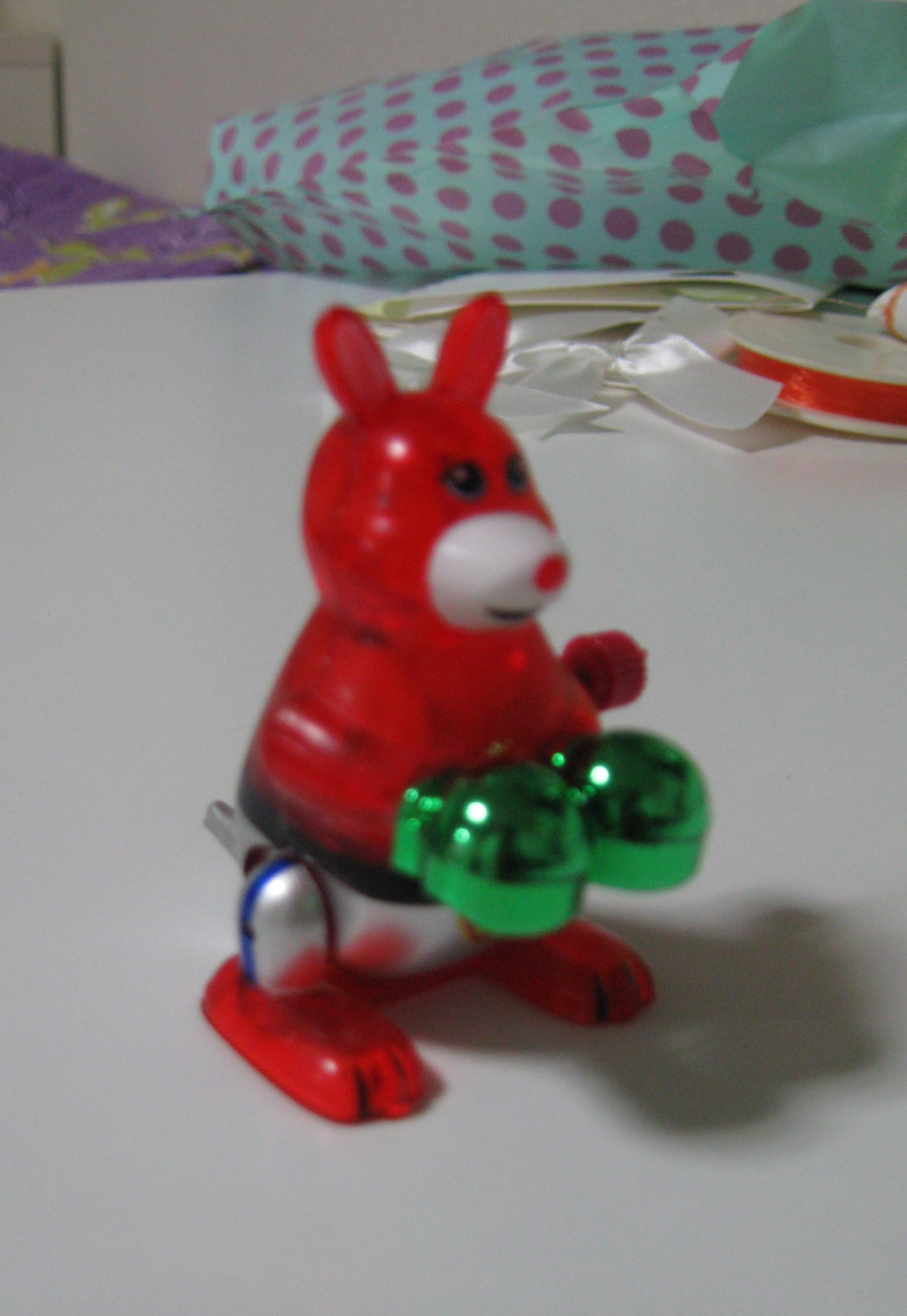
Kanga – fighting!

I got this little wind-up toy for Jane as a wedding present, but he got crushed before I could give it to her and he exploded in pieces when I took him out of my bag.

Turned out his spring had popped and it’s taken me several days to figure out where the start and end points of that tiny spring were.

But hooray!  I finally got him slung together and super-glued him shut, and he’s so happy he’s doing back-flips!

I love mechanical toys!

It’s half Korea

Once a long time ago I was reading Dave’s ESL cafe, as all people interested in teaching English in Korea do at first when coming here before they realize what a toxic place it is, and this one guy posted a revelation that Korea has an insecurity/inferiority complex, and that it explains so much about Korean actions.  And I’d only been here a month or two and he’d been here for a couple years and I’m like, “duh!”

Well, today was my revelation.  I’ve always been totally dumb-founded how nobody steps up to take care of the foreigners or show them around.  It seems as if they’re totally self-absorbed and don’t give a crap about people other than Koreans.  And it just hit me today that the reason I always bend over backwards to show new people around my town, my culture, my life, is because I’m EXCITED about it! I LOVE the opportunity to show people what I love!  To share anything I’ve learned, to give them any insight, to not have to reinvent the wheel and help them have the most efficient settlement as possible.

Koreans just aren’t excited about their own culture.  They mostly feel obligated and oppressed and tired and it’s not worthy of sharing.  It’s also all about family.  And family to them, except their little ones = burden.

So maybe you’re saying, “duh…” about me right now.  Or maybe you hate me and think I’m a Korea hater.  But that’s not true.  I want to love Korea.  I’m just having to work a lot harder at it than I ever dreamed…

I’m not drinking makkolli right now so I can remember those English words every Korean who says they can’t speak English to me can say without hesitation, and they are:

  • sorry
  • nag
  • sexy
  • stress

and “Hello how are you I’m fine and you?” and “help yourself.”

Similarly, words all Koreans seem to understand without translation are burden and suffer. Many a time I have had to change my explanations around to include these words to explain some concept and suddenly the lights will go on at their introduction.

I mean, doesn’t that say a world about how Koreans think?  These words are important to them, and the rest are phrases out of a textbook that they use as a catch-all panacea for every encounter with a foreigner.  I also want to add that I’m not belittling their language skills or intelligence here, as my vocabulary in other languages is about the same size.

What I’m saying is, the words we choose to remember, they say something about us.  Like I can’t remember how to say anything in Spanish anymore, but damnit, I will always remember la madrugada, arco iris, and lagrimas.  Those words say a lot about me.  I didn’t bother to learn the words for burden and suffer in Spanish because the Latin people and culture I’d been exposed to didn’t think about life that way:  those are passive words, and Latinos are about action or dreaming about action or romanticizing. In fact, I never used those words before I came to Korea…

I was just so surprised so many people I’ve talked to know the word nag, for example. That’s just barely part of my American vocabulary and I almost forgot it was a word at all, but it’s obviously registered with the Koreans I’ve spoken with.  A Korean mom is very much like (sorry in advance) the caricature of a Jewish mom.  And Korean family gatherings (I’m assuming) are often an ordeal for people to live through.  Because Korean culture is all family based, I’m thinking a lot of people really don’t want to revisit that ordeal so they can share it with foreigners.  It’s all intertwined, and it’s messy, and it’s a personal conflict.

And then there’s the great-places-to-go thing:  I think they don’t take people to great places because then they’ll be obligated to pay for the entire thing, which is, frankly speaking, one of the most annoying things I hate about Korean culture – that one person has to shoulder everything and it is for the glory and it is a curse and that people just hope that the paying-for-everything karma will come back to them and then resent it when it doesn’t…

But I digress.  Somebody needs to teach Koreans that they can welcome foreigners without all this baggage.

But given all the above considerations aside, there’s still missing a lot of compassion for the foreigner’s experience here.  And that, I think, is born out of a)insecurity about communication b)self-absorption and c) envy.

OK.  This sounds like a lesson for my kids.  Welcome to Seattle.