don’t press that button: look up

This week I helped two adoptees who know family member names get in touch with a man who can help them find their family, while Jane researches and corroborates information from adoptees with amazingly accurate memories.  On the other hand, I wrote Kim Sook Ja last week and haven’t heard back from her.  And I offered to let another adoptee in on my Wonju area newspaper connection and haven’t heard from her.  And so it goes: there is a time and a place for each adoptee’s search and it has everything to do with how open the adoptee is to dealing with the unknown, and that is no small thing…

But what’s really on my mind is Eleana’s book, Adopted Territory!

If I seem obsessed by it, it’s because I am!  I occasionally skim KAD blogs, I have skimmed books on adoption only long enough to replace them on the shelf, and I get personal tales from every adoptee I talk to in person.  And the academic scholarly tomes are sometimes too esoteric or dense, which I chafe at because I’m a generalist and a populist.  And unlike most other adoptees I know, books on adoptee healing make me want to hurl.  Some love (and some hate) Joe Soll, for instance.  And others always reference Primal Wound by Verrier, but the snippets I’ve sampled do nothing for me.  Books on things that I already feel or know intrinsically I find tiresome to read and I ultimately feel we need to take the plunge ourselves, as I’m deeply skeptical of psycho anything, and believe we need to investigate ourselves and write our own books about what works for us.  I think the process of re-inventing the wheel is pretty important.

I’ve only really read or been impressed by the intro to Outsiders Within. To be honest, the anthology of works inside didn’t pull my grinch-like cold heart either.  Nor do most adoptee tales.  In addition, I don’t appreciate being lead towards another person’s conclusions, nor do I always agree with them.  That’s why I liked the intro to Outsiders Within so much.  It was just an intelligent overview of the transracial adoption situation in a global framework, an adoption 101 if you will, and it was refreshingly unemotional, which is what I needed at the time.

Eleana’s book is like that too.  It is fair to all adoptees no matter their politics, rich with history, and very nuanced.  It’s a very good piece of journalism, coupled with analytical tools that anthropologists employ.  And as unemotional, rational, and observant as it is, I had to catch my breath at one point and hold back a tear.  And that doesn’t happen to me much anymore.  And the reason for this pang in my heart was just realizing I was a part of something huge.  It was a blast of stiff wind that assaulted my senses, realizing the sheer scale of what we were subject to.  As a mass experiment, arguably for good.

I mean, I remember how excited I  was when I read on The Adoption History Project‘s pages (hazah!  yet one more writing I can back – that and the Evan B. Donaldson Adoption Institute research) how social workers questioned whether or not it was good to subject children to still further trauma forcing them to assimilate in another culture.  Eleana’s book doesn’t summarize like that – she provides a huge amount of historical research:  social worker quotes, news articles, etc.  of contemporary criticisms, Holt’s pressing forward, children’s rights being ignored, families being separated coming to light, and gross cases of ugly adoptive parent entitlement rearing its ugly head even from the beginning.   All the stuff you read about today?  The same debates we fight about now were there right from the beginning and social workers (bless their hearts), journalists, and others who thought for more than ten seconds were raising their concerns.  Only they were powerless to help, because the post-war fervor was too great.  It was exciting to get my hands on more fact-based, historical research.

So that wave of recognition that I was part of something huge came about half-way through the book when I realized (owned) that the whole book was about us adoptees coming of age enough to empower ourselves and critic what had happened to us, from every angle imaginable.  The sheer number of how many of us were deeply affected just hit home, and I no longer felt like such a lone voice: even though I am a late addition to the choir, we too often feel we are singing solo.  Her book was, for me, the same as A collection of one was for many of the adoptees I talked to:  both memorial and testament, which made the incomprehensible somehow very tangible.  That this is real, that this chaos we live with is not some figment of our imagination, that we very much are part of something larger, and that we aren’t the only ones who suffered.  And it is also somewhat awe inspiring.  We can be proud of ourselves for weathering as well as we have under the circumstances, and the sobering reality that we are still living apart from those around us, and how difficult it is to create own identity in isolation.  And Eleana’s book gives each and every one of our perspectives a voice.  This book may be about us, but it is also very much for us.  The most impressive part being how all-encompassing it was, yet at the same time verbalizing the individual adoptee perspective so well.  So her choice of an image from A collection of one for her cover is, therefore, especially appropriate and meaningful to me.  They are both doing/saying the same thing.

Highly recommend reading this book, simply for the exercise of not looking at our navels, but outward at the world and our place in its history.  And in doing so, I think we learn much more about ourselves and gain a sense of where we fit into that picture.  And that, to me, is far more healing than any self-help book.

part of history being made

Writing a blog about my experiences as a pseudo repatriating returnee adoptee has always just seemed di rigueur.  I’d read a couple KAD blogs before coming here and they always shared (although in a very guarded way) their experience of coming here and searching.  So I thought it was my responsibility to do likewise, and also because I’m terrible at putting a letter in an envelope and even worse with my phone inhibitions and fiscal phone bill conservation drummed into my head by my depression-era parents, I thought it would be a good and cheap way to let those who care know what’s up with me.  I thought it would be interesting to document this process, as I knew it was going to be treacherous, messy, and a growing experience, and maybe it might benefit others like the blog reading of others had benefited me.

I didn’t really think about how my blogging or my experience would in any way be unique or different from any other KAD, though I realize now  it’s quite different in that most of these  bloggers that search don’t stay in Korea an extended length of time, and those that have didn’t document that process.  (except Jane, who writes books instead of blogging in the true blog-as-journal sense)  I also had entertained, prior to coming here, helping out with TRACK, (another atypical aspect as few adoptees wear the activist hat for long) who had captured my imagination from the first time I saw this video:

Knowing myself, I knew it wouldn’t be wise to join up right away, since I wanted to dive into Korean lessons and had to adjust to teaching and Korea first. But three months later, I showed up at Bosingak bellfry anyway and after attending a few meetings realized they really needed more than warm bodies and that maybe my needs weren’t so pressing when looked at with relativity.

With all the adoptee blogs, etc., and all the home-land tours and the culture camps and the reunion shows, I thought adoptee organizations were pretty established and so I figured I was joining an organization that had existed for a long time, tackling larger issues (like the video above) for a long time.  But actually, it’s pretty new and I didn’t realize until recently that I’m in the thick of a huge shift in consciousness in adoptee thought and action, and that that video I stumbled across was almost at the beginning of a more pro-active alliance with our equal partners in trauma, the moms.

Reading Eleana Kim’s book is really REALLY enlightening and informative.  An anthropologist, she’s actively observed the emergence of adoptee group dynamics and sensibilities for over twenty years now: almost from its inception, she’s been there. And because she’s put in the time and so thoroughly, exhaustively examined each and every possible thought process in adoptee positioning of themselves and exerting their own voices relative to the institutions, nations, and people who have put them in such an ambiguous position, she has managed to outline the myriad issues in a far more eloquent and all-encompassing way than most of the adoptee writing I’ve read.  Because it isn’t the individual voice which has the greatest power, it is when voices act together, and so her study of the “politics of belonging” is really most cogent.

Reading her book was infinitely relatable, because the awkward politics of identity reclamation that outspoken adoptee pioneers had to go through to get to the point where they are today, in all their iterations and polarizations, directly parallels the process this adoptee went through internally in the past three years.  It’s fascinating for me to get a history of some of the convoluted, complex relationships and internal politics that have occurred between and betwixt the adoption agencies, governmental agencies, adoptees, and organizations.  And it’s most bizarre to see the names of people I meet and get a sense of their activist resumes and read quotations and see how this whole thing was born!  How really bizarre to be part of this on-going thing, the subject of books, a movement!  And I read about these people who I brush elbows with, and I can no longer take them for granted.  Mammoth people who blazed the trail.

Where I left off was at the point where adoptee activists who sought credibility felt it necessary to censor themselves and keep their personal stories private.  And here I am doing the exact opposite.  And I guess my writing style/personality which has been informed by my poor adoption outcome is somewhat unique in that it does not censor that reality in order to keep my politics stain-free/pity-free and above reproach.  I guess because I don’t see that history as dis-empowering at all, nor do I see that its reality in any way negates logic and reasonable analysis of what is a flawed system.  I actually see it as a seat of strength, because it humanizes me.

When pastor Kim gave me flowers for being the sacrificial lamb for my public disclosure with the media, I didn’t really agree.  Revealing all was no sacrifice on my part, though being edited did not sit well, as I didn’t want to reveal just part, but all.  But maybe, if I re-frame his appreciation to mean, “thank you for going all the way.”  Then, then those flowers have great significance to me.  There are times when Jane or others tell me I’m inspiring or brave, but I don’t really agree with that either.  I prefer to think of it as  just being real.  Maybe that’s not so common, but hopefully it can be.

When I occasionally go to other adoptee blogs and find posts blocked for privacy or adoptees who have burnt out and shut down, I get a little sad, though I’ve totally been in that place.   Because I feel they are stopping short of going where they really need to go, which is to dispense with the comfort of privacy and avoidance of retreat.   Speaking to you is what heals me.  It is this messy unflattering act wherein I find the trans-formative process.  I feel like adoption politics is maturing and finally, so am I.

I’m feeling pretty blessed right now.

Happy Birthday, baby!

The theme of the day is birthday – for my work with TRACK and because my so-called birthday is coming up.

So I type in “balloons Seoul” to search for birthday balloons,

and what’s THE VERY FIRST F*****G HIT I GET?


Do Americans have ANY IDEA just HOW MUCH they are entitled to children from other countries?  Do non-adoptees have ANY IDEA just HOW MUCH this shit is in our faces?  All the time?  Everywhere we turn?

Note to myself:  never shop for birthday decorations on-line.   Not that I would do this for myself, but it seems I can’t even do it for others!

**********

Had to run to a main branch of Nong Hyup bank today, since CheongPyeong’s won’t handle foreign remittances and my on-line banking requires me to enter my town in the foreign remittance form, but my town won’t show up…

Anyway, it was nice because I got to almost finish Eleana Kim’s book, Adopted Territory and I didn’t even get car-sick on the bus reading it!  THAT is amazing…

Turns out the bank was closed.  I’m an idiot – I forgot that the reason I have the day off (the day before school begins) is because it’s a national holiday, even though I don’t know what the holiday is.

click on the photo for Kim Chi Ice Cream's restaurant review

It’s all right as well – I wanted to check out a restaurant I’d seen in an ex-pat blog.  It’s called Peace of Mind Book Cafe.  And it was really lovely.  It was so lovely, that I splurged and treated myself to a big 1″ thick steak.  The rosemary infused reduction it sat in was a little too salty, but the steak was to die for.  The first steak I’ve had in probably three years!  And a salad and the owner added as service one of their famous hot-from-the-oven breadsticks, which was more like a super skinny rustic baguette.  Fantastic.  And I’m not a bread person.  But it was perfect.  And even some olive oil and balsamic vinagrette to dip in.  Oh!  And I had a glass of wine – I never have wine anymore!  Altogether, it set me back about $30, but hey, almost happy birthday to me!

Anyway, the owner lived in New York for three years and speaks really good English.  I asked him about advertising, hoping to learn more about direct mail in Korea, but he doesn’t use it because his restaurant does well by word of mouth.  And then I told him about me having to get creative since my birth family search didn’t work.  So he suggested the local papers before blowing money I don’t have on direct mail services.  The owners of the Gangwon papers meet there once a month, so I’m to send him my story and he has offered to present it to them for me.  Gangwon, btw, is the province in which the place I was abandoned, Wonju, is located.

So I sat there, listening to Chopin, sipping wine, and finishing Eleana’s book.  A very nice day, despite starting out wrong.


Migook means beautiful land

I grew up in the middle of the UAW midwest, on the outskirts of motor city in a little strip-mall town called Taylor.  Once upon a time, before urban sprawl, it was a little train station outpost called, Hand, but during the 50’s and 60’s it exploded into block after block of post-war subdivisions, fueled by G.I. bill mortgages and big three assembly-line salaries.

It was during these times of prosperity that all across America, to seemingly every remote location, were broadcast little Korean children into the arms of mostly well-meaning, often socially conscientious families with room in their households for more.

And all across America, (actually the whole world, but we’ll concentrate on what I know) these scattered Korean seeds were deposited in similar towns that shared, if not the car culture, at least this post-war feeling of prosperity and generosity.  And prejudice.  Because the rescued children just happened to share the same features as the recent enemy. (and in other countries, their colonies)

And so we were ridiculed, mocked, humiliated, and sometimes assaulted.  Again and again the experience was replicated in each and every remote location of deposit.  With a surprisingly/alarmingly similar dialogue, as if there was a template for hate being distributed without our knowledge.  It was as if it was a backlash against all the frustration that Americans felt for not being able to vent their spleen at the Japs or the Korean commies in times past.  And as I was growing up, it was also a backlash for what was going on in Vietnam.

I was nothing but a stupid gook.  It wasn’t until just recently that I had thought gook was in reference to Vietcong, because I’d always seen them being referred to as gooks in Vietnam war movies.  I was used to being called anything Asian but Korean.

It wasn’t until coming to Korea that I learned Migook was the word for America, and that Migook really means “beautiful land.”  And it wasn’t until this morning from another adoptee that I heard the likely story that Koreans saw American soldiers and said, Migook. And the soldiers thought they were saying “Me (I’m a) gook.”

How did they know it was a beautiful land, I wondered?

My other adoptee friend recalls having a ball thrown at her, while being derisively called Chinese.  By an older boy.  In front of his parents.

I also recall this kind of display of racism.  Proud.   Proud to be racist.  Seeking approval from their parents, who gave it to them.  I recall going to friends homes and listening to their parents swear about God damned Chinks and Japs in front of me.  It was okay because they knew I wasn’t Chinese or Japanese, but to everyone else around me I MUST be Chinese or Japanese or Vietnamese, because Koreans didn’t exist as an ethnic group.  Everyone knows we all look the same.  Everyone knows we’re all the same (yellow) and the differing countries were just a geographic technicality.  I was reduced to a slit eyed moon face by people who could mimic Chinese far better than I ever could.

(chant, in sing song voice)

My mother was Chinese,

(pull slit eyes up / buck teeth out)

My father was Japanese,

(pull slit eyes down / buck teeth out)

but I’m just a crazy mixed up kid!

(pull one slit eye up / one slit eye down / contort mouth)

One time the riding was so hard I ran home crying.  My brother interrogated me, went and knocked my best friend’s brother off his bike and told him he better not do it again.

But that was the first and the last time I broke publicly.  Because when you live in car country, and Honda sales mean Uncle Ray got laid off, every day is bash Japs day, and who you gonna cry to?  And if you do, what are they really going to be able to do for you?

Your brother’s not going to get physical again.  Your meek liberal parents are going to talk about love and understanding and ignorance and patience and forgiveness and be self-satisfied and go back to enjoying their white privilege.  The answers can be found in books written by experts, and there’s nothing that a rainbow family can’t overcome.  So it’s a small matter, that will go away as the world gets more educated through open-minded acts of tolerance like making adoptive families.  There’s a reason you’re a poster child for social justice.  It’s your role to educate the planet; to provide comfort – not seek it.

And so it goes, after the Korean war you could hate the North Koreans yet call all Koreans gooks and after Vietnam you could hate the Viet Cong and call all Vietnamese people gooks and you could come home to America and call all Asians gooks.  And when the Japanese produced higher quality cars you could hate the Japanese and call all the Japanese gooks.  And you could bring home their lotus flower daughters and make them your wives or leave them to rot and rescue their half-breed children and call them gooks too.

Beautiful land.  Where our faces mean torture and P.O.W.’s and me love you long time sex and trade quotas and job loss and missing limbs and lost minds.  It’s enough to make you want to punch their face.  Incite a fight. Or rape them. Or make them lick your boots.  Or   here’s    the   b r o o m    c l o s e t,  please   put   the   broom   back   when you are finished.

Adoptive mom and co-worker with her very dark Indian child chats me up to talk about adoption.  She’s wearing all the markers of a socially conscientious Pacific Northwest mom.  The conversation touches on racism.  “Oh I’m not worried at all.  Kids these days are pretty accepting.” I guess she hasn’t read about the middle east lately, or that we’re in a war there.  I’m sure her child will never tell her about being called towel head or hadji or…I mean, what’s the point?  All she sees is a the good she wanted to accomplish, the sacrifices she will make, her own contribution to this child’s more comfortable life and better opportunities.  She will never know what it’s like to be a gook in beautiful land.  But her poor dung-cooking, garbage heap dwelling, barbarian adoptee will.

“Why don’t you go back to your own country?”

I’ve been asked this, rhetorically, of course.  (or maybe not?)  At the time I felt enraged as a multi-cultural American, but in retrospect I never was multi-cultural.  Adoptees are never multi-cultural after assimilation. And (though scary as hell) that unmasked hostility is actually refreshing in its honesty, vs. the dishonesty of color-blindness.

So you do go back, only there’s no place for you here either.  Koreans think you were sent to beautiful land.  They are envious.  You should be grateful.

shoulda been desk warming

All the foreign teachers hate school breaks because, while the over-worked Korean teachers finally get to chill at home, the foreign teachers have to fulfill their contracts and come to school and pick their noses.

Only this foreign teacher has been writing the corresponding book to go along with her morning broadcast, and freaking out because she doesn’t have enough time to get it done before school starts.

Turns out there won’t be a broadcast in the mornings (because both the English teachers are home-room teachers this year), there may not be a broadcast at all, the book may not be printed, and I won’t know about it until probably next week, just before school starts.  Neither will I be writing my own curriculum this year, but will instead be following the Korean national curriculum.  Which makes sense, something I’ve thought was a missed opportunity all along – reinforcing the lessons the kids are getting – but which also sucks because I have to ditch a lot of good things I’d come up with from the last two years and have to start all over again.

One of the books is really awesome, heavy on the speaking and listening skills, and the other two books SUCK.  All of them the lingo is slightly out-dated (and here I am approaching half century)  The worst books have a script for the Korean teachers, as if they were trained monkeys.  I guess in this case the robot teachers would be really appropriate. I feel I should be sitting in every class, making corrections, but there’s only one of me and I’ll only see the students twice (? – have no idea yet – haven’t been told) a week.

Anyway, all this stressing about getting the book done and mapping out a year’s curriculum and coming up with an engaging first week of lessons – all totally pointless – I could have been doing something productive for TRACK or writing the great American novel or something.  (And here I’ll sound like the old-timers on that toxic techer’s forum, Dave’s ESL cafe) But we’re in Korea, where every decision is last minute and nothing is planned in advance, so it’s really not worth your while to take any initiative…

So today, today I am just taking out my red pen and marking up their text-books.  And checking out all my facebook friends…

It’s a dog’s life

Yesterday it was the last day at CheongPyeong high school for 10 of the teachers, who were moving on to new assignments.  That’s a third of the teachers!   We picked up 8 more as well.  Each one was almost on the verge of tears at the gEditood-bye ceremony.  After school there was a big dinner at a Chinese restaurant for them.  It was unlike any Chinese food I’d ever had – elsewhere in Korea or in Chinatown in Seattle or anywhere.  Maybe it was the real deal, don’t know.  Not very appetizing looking, that’s for sure.  I was definitely in an msg coma afterward.

First time I’d seen teachers tipsy.  There was some Chinese spirits on the table – 56% alcohol and 50% alcohol.  There was also Korean soju at 27%.  Most of the teachers were taking the next day off, I guess.  The funny thing is that those who can’t drink because they’ve got responsibilities to attend to, or those that just don’t drink, all PRETEND to drink with Fanta or cider.  They do the whole ritual pouring and making rounds and toasting, etc.  with great flair.  It feels strangely like having a miniature tea party like when you’re a child.  They were going to continue on to more drinking and I wanted to for once hang out with them, simply because maybe alcohol would cut the communication gap a bit, but I had too much work to do and went home instead.

this is for my daughter's boyfriend Mark - these are the soju drink boxes I told you about - they're less than a soda (900 won is about 85 cents U.S.) and available at any convenience store.


Today I had to go get my alien registration card renewed in Chuncheon.  It was a glorious day outside, like the first day of spring, and I had to check myself not to get too excited, since it’s far too early for warm weather.

Decided to take the bus since it’s closer to Immigration, when who should I run into but the world’s friendliest Korean!  He insisted on buying me a coffee from the vending machine and gave me his card.  I asked where his name was, and he said, “have none.”  And then he went back to studying his pamphlets again!

I always love the ride into Chuncheon, by any method, though I prefer the bus now that the new Korail line is totally over-crowded, and at twice the price there are plenty of comfy seats on the bus.  From that vantage point, one can really almost love it here:  the beautiful mountains, the graceful pines, the manicured grave mounds and family markers, the neat farm rows…On those mountains I can picture a small silhouette of myself as a young mother, anachronistically wearing peasant hanbok, baby on my back.  traveling >somewhere< with purpose.

Unlike Seoul’s Immigration office, there’s nobody waiting in Chuncheon, so it’s pretty pleasant.  But it still takes awhile.  Like every other alien-related thing I’ve had to do, someone always has to call someone else and talk for a long time, and then you have to go to another office and wait while they decide they have to do exactly what you knew they would have to do.  My card was expired and I knew I’d have to pay a 1oo,ooo won fine, why didn’t they?  Then it turns out you have to walk to the nearest bank to pay the fine because they don’t take cash or credit.  The only reason I can figure for this is because of past bribery.  But then the renewal fee of 30,000 won – which in Seoul you have to go purchase revenue stamps – again probably for the same reason – here you pay in cash.  (hmmm……)  The funny thing is, 130,000 won lighter and all they did was write the new expiration date on the card with a sharpie and cover it with tape!

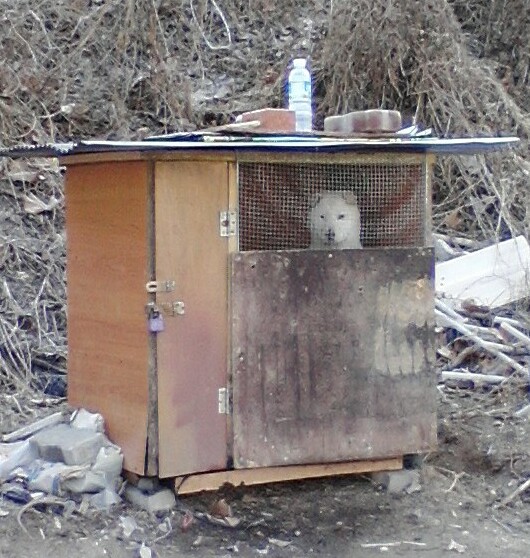
On my way back from the bank I found this little guy:

I’ve no idea why he’s locked up like that!  I felt like springing him free, but didn’t act on that impulse.

You know – like another foreign (white) friend was saying recently, Korea’s okay.  Living here is not so bad, some things are great, some things (like the photo above) you can’t wrap your head around, but it’s just too different from what we’re used to to want to stay.  And the reason is not the quality of life or the culture or…it’s the people.  (and this is almost a direct quote)  “Individually, they’re mostly all pretty nice.  But as a group?  As a group they stop being lovable.”

Exactly.

It’s the hypocrisy.  Left and right and up and down and everywhere.  It’s all about image here.  Judge and be judged.  Even those that hate it let it rule them.

Collectivism, like communism is a nice theory – doing your part for the common good – but in practice?  Anxiety about not getting your share or not being rewarded for your unequal efforts creates an unholy climate of competition.  And then the mechanism for controlling people is built right in, only with collectivism opinion is the whip that bites and keeps people oppressed.  It’s genius, this self-regulating oppression.  I’m sure those in power love it.

Meanwhile, it sounds like America is really going to hell.  It sounds like what my high school was like, where they’d taken away the art and music, where there were only basics taught, where there were no janitors and the kids cleaned the bathrooms on detention, where the principal swept the floor, where our fourth of July parade was silent because there was no band…

You can spend centuries building a great experimental society and you can lose it in just two decades.  That’s what happens when the wealthy protect only their own interests.  And we let them get away with it.

Either side of the ocean, it all goes to hell when every man puts fears for himself above all else.

Meanwhile, I saw Samsung passing out brochures to students on graduation day.  I hope it wasn’t for a college credit card…

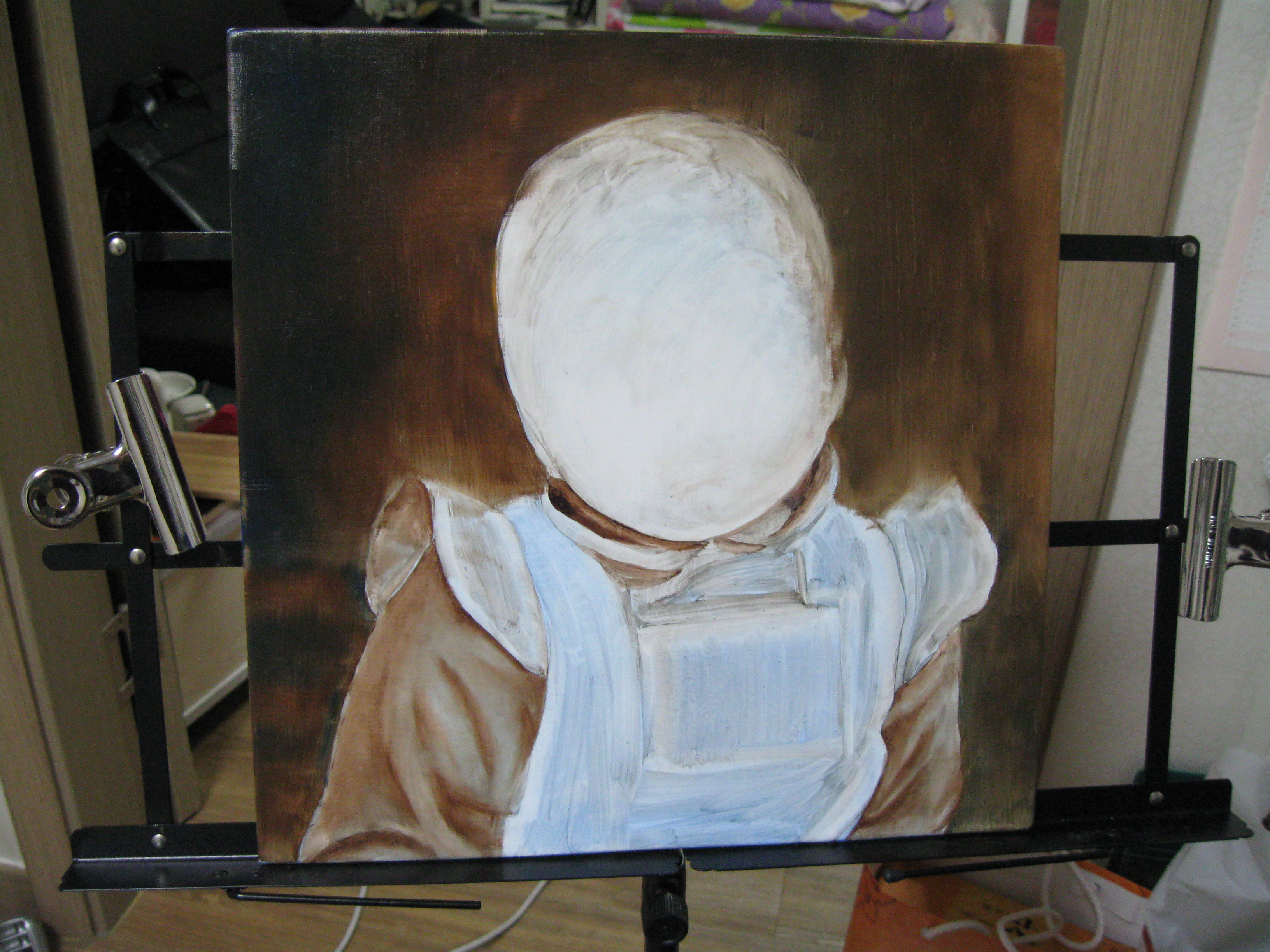
I really shouldn’t be writing right now – I’m so swamped with work, I’m drowning.  So drowning I can’t deal with it at all.  Art saves the day, though!  It’s like a mini vacation from the mountain of things I should be doing.  Here’s my very first oil painting portrait:  of one of the adoptees who was in the art exhibit.  It’s only part of the under-layer, a little less than three hours of work.  Many more layers to go…

Oils are kind of perfect because I don’t have time to paint all in one sitting, so I can pick away at this.  I’ve only done one still life and one abstract in a class in college, and the instructor was really lousy – he only taught us how to prepare the canvas and take care of our tools.  I learned more watching youtube for a day last week than I did from him all quarter!  So anyway, this is kind of my test case, as I don’t have a feel for it or any techniques.  But I’m also not worried.  Miwha says I don’t need to go to school, just practice whenever I can.  But I think I need the rigor and I want the exposure to what contemporary artists are saying that’s changed the world’s perspectives.

So far I’m discovering:  to stop thinking of paper and paint as precious, even if it’s expensive as hell – to not scrimp and use as much as you need.  to stop thinking you need the best tools and materials – these cheap ones are just fine, (like my music-stand easel?) that a variety of shapes and sizes of brushes really IS nice to have, that it’s a waste of my time to draw anything first (which I didn’t here) since oil can morph and correct itself, to not listen to any rules about how you should do anything (at least those not based in science) and that even if this is just practice, this is really where I want to be.