You know, being stuck in Korea it’s easy to lose touch with what’s going on back home. I worry about all that I’ve missed out on and if I am so yesterday that I won’t fit in anywhere. Not that I ever really fit in there – just kind of floated on the edges of fringe but was never really fringe, and on the edges of local, but not really local, (though 26 years in Washington, only 5 of them outside of Seattle makes me more local than most) and…but I did feel really versatile and familiar and comfortable there.
Just this weekend I heard about Portlandia for the first time. So I’m a year late – I mean, I AM in another country and all. OMG! Total riot! For those of you who haven’t heard about it, I posted a couple little clips for you below:
Now, I’m from Seattle and not Portland, but everyone in this video could have been from Seattle. Portland is the Seattle that Seattle-ites wish they could be,
(hyper recycling, hyper cycling, hyper well-read, hyper-organic, hyper-cooperative, hyper p.c., etc.) and Seattle is (was?)/has the world recognition Portland wishes it could have had, though maybe that’s not esoteric enough and it would rather have the kind of counter-culture renown that the Olympia, Austin, and Atlanta of old had, because everyone knows grunge is over and Starbucks is over…but mostly the differences between Seattle and Portland people are really minor.
One thing that cracked me up was one youtube respondent’s complaint that the people spoofing Portland were all from the Midwest.
Well – the thing is a lot of the hipsters the spoofers are spoofing are also from the midwest! It’s not just the dream of the 90’s – it’s the dream of the midwest! Too funny.
The spoofs are so real they hurt. I think every character in this show has been in my life. (at a safe distance) Love this show and can’t wait ’til the new batch comes out next year.
Anyway, Pacific Northwest – I love you in spite of your hipster pretensions – and I know that for the most part you mean well and try to walk your talk – and it’s unfortunate you talk too damn much and are so insecure, but I love you anyway…
A few weeks ago I wrote about constructed identity myths. And also about having “an awakening” about adoption and abandonment as being the root cause for all my woes. But what I didn’t explain is that I think the latter is part of the former.
I have been thinking lately how privileged I’ve been as an adoptee to have adoption to blame for everything not going the way I imagined the world should go. I have also been thinking how fortunate I am that it only took me three years to figure that out. And I thank God that I didn’t dwell in that “awakening” for decades like other adoptees I know. And this is not to discount the effects of abandonment or adoption or to dismiss it, because it’s really freaking traumatic in a majorly traumatic way, but it is to say that the real “awakening” is not that it is the cause of a bad life today, though that may be true, but that the important truth is that we need to realize we have to find some healthy way to deal with that pain.
I’d hoped that adoption activism was a way to do just that – move on by making something positive out of the trauma. But if the source of that action is based in blame, then is it really positive? Peel back the layers of adoptee activism and what you have at its core is a cry for validation through blame. But if no validation manifests itself, what is left is only disappointment. Are adoptee activists prepared for that?
It has been posited that the adoptee diaspora is its own unique species, and that the species will soon be extinct and that we must be recorded in history. Adoptee activism is about finding some action to anchor a place in history so we are not forgotten. The goal is validation.
Yet, the only people validating the wronged Korean adoptee is Korean adoptees themselves: adoptees who have also decided that adoption is the cause of all their ills. While some westerners and a handful of Korean radicals recognize our difficult situations, they still don’t validate us historically. Speak with any other Korean national and we are just a sad footnote in a long tragedy-filled history. Essentially? They just don’t care. “I’m sorry for you. But don’t expect any change any time soon.” Just like many other displaced people and victims of circumstance, politics, war, genocide, etc., there often is no justice for the living. There is no validation for us and there will be no Truth and Reconciliation Commission on adoption, because laws were not broken in a lawless state and Korea will never indict itself for ethical violations like that. And the more we irritate Korea, the more the adoptee community is seen in dim regard.
And what kind of goal is validation, anyway? It is a goal of self-soothing, a goal of delusion, a goal of constructed romantic radical activist myth-making. It is ego.
Now, we CAN validate each other and support one another, but it should be cleansed of these delusions that we can make Korea do what we want, or that Korea is where we belong. Koreans are concerned with their lives and their needs and getting ahead. We are nothing but a momentary pang of guilt to them.
Thursday I spent with foreign teacher friends I met in Thailand prior to coming to Korea. Of 10 of us, only 4 remain, 3 of which meet regularly, and this was a special occasion as one who had already left was back to visit. Unlike other foreigners here, I don’t have to explain what I am to them, and it’s refreshing. It was refreshing to be with friends who did not commiserate over drinks with the requisite box of trauma tissue handy. It was refreshing to only need tissue because we laughed until we cried.
Two of us may make Korea our home and I am not one of them. Because the fact is that I do not now and never will enjoy the Korea that they experience. Nor will I ever enjoy the Korea that Koreans experience. The fact is that adoptees do not belong and are not welcome here. The adoptees who stay? They are refugees seeking shelter from a world in which they couldn’t cope. But here they are also outcasts, and they are not coping well. While I have been horrifically educated by abuse and adoption, and I can never erase the fact of that, I still think that trauma can inform and enlighten instead of just shackle and imprison.
I deserve a better life than this, and by God I’m going to get it. There is only so much space in our lives, and if we devote most of it to our trauma, then how much room does that leave for happiness?
I know that people will be disappointed that I no longer champion such dreams. I know too that my conclusions will not be popular: because people want to feel righteous and that dreams of reunification and repatriation are seductive and soothing, and everyone would like to be a social justice hero. At the beginning of my journey I wanted all those things too. I am, after all, a transracial adoptee abuse survivor. But we have to find hope in reality, if we want to live real and productive lives that transcend survival. While not as romantic, I hope just living in peace can also be inspirational for some.
Whatever shall I write about now? Ha ha ha! Still 10 more months here and then readjusting to America to follow. But somehow, I think it’s going to be pretty smooth sailing from hereon in.
ADDED:
Oh, and just to be perfectly clear — I still think international adoption is violence to children and that it is rooted in colonial entitlement and I still think the adoption agencies broker the sale of people for profit and charlatans hiding behind charity and Christianity.
I will continue to look for ways to contribute to the demise of these horrible practices, only I’m not going to do it at the expense of the adoptee community or my own happiness.
Monday I went on my monthly excursion into Chuncheon to send money to myself, since it’s difficult and expensive for me to do so at my local bank which originated from an agricultural collective.
Anyway, it’s always a nice trip. I splurged and ate at Pizza hut – had pasta and a salad bar – still not sure if it was worth 3 times the price of Korean food…
But afterward, as I walked down a little cluttered side street to purchase cigarettes under the moonlight and streetlights, I had to pause and dance a little in the street. Those were the days my friend was being cranked out of some speakers from a little shop selling ajumma clothing, and – I can’t describe it – it was so charming and uplifting. I’m already nostalgic about Korea, even though I haven’t left yet!
So I wanted to share something with you that I wrote on an adoptee support board.
…I am often asked by other adoptees here about when I started being active with other Korean adoptees, and they are shocked to hear I never met another Korean adoptee until just before I left for Korea. I tell them about never acknowledging that adoption made any difference in how I asserted or defined myself, and that it took a crisis for me to figure out that amazingly obvious cause for so many of my woes. “That sounds like you had an awakening!” said Tobias Hubinette. Yes. Exactly. And the entire journey since has been all about searching – not for identity like I thought – but for authenticity.
It’s my sadness that the other adoptees around me just-don’t-get-it. They’re falling short of the hard work and feeling sorry for themselves and feeding on their anger. They’re not paying attention to their crisis or listening or caring for themselves. I feel very fortunate also that I’m doing this so late in life. It’s analogous to me going to college ten years late. Age and experiences have certainly informed me and kept me from being lured in by many of the pitfalls of Korean adoptee identity search, which includes a lot of dysfunction and slow death. Throwing myself in for the full-on experience with no quick exit has also been really essential. Many adoptees return to the land of their birth and then leave before anything can be resolved, return to their adoptive countries and feel alienated and restless, return again to the land of their birth and then leave again before resolving anything.
My search was just like anybody’s and couched in terms of birth family search, or wanting to learn about my culture, or wanting to get over my fear of people who looked like me, etc. I think many adoptees search for signifiers of anything that can give them an identity, but they find themselves unsatisfied because they don’t really OWN those things. Let’s face it, false identity is what we know best, right? It just seems like so many end up trading one false identity for another false identity. The exploration of abandonment, relinquishment, race, culture, etc. are too often held onto as the crumbs of what was left of our selves, and too many adoptees stop there, defeated or angrily hanging on to these crumbs as a new poverty-stricken, original-looking yet still-false identity. But for me, it took looking at all those things IN CONCERT, for a prolonged period of time, to give me a sense of the shape of my authentic self around which all those things revolved.
It’s all very nebulous. I think that’s also one of the difficulties, is that people want to hold something in their hands, have something to look at, be called by name and recognize it. But really, who we are is intrinsic to our persons and uncovering our authentic selves when so buried is a process of elimination. Stripping away all the lies we tell ourselves. What is left over is what we are. And it’s not corporeal, right? It’s an idea.
I’m soooooo happpy I did this most hardest thing in the world, by being totally destabilized in every single way possible. It forced me to face every false identity and kill it. And writing the blog also helped, as I’m sure that the talking cure – though it seems like a waste of time – actually is hugely beneficial because the process of facing everything awful and hitting it again and again and again just makes the awful dissipate. The process of hacking away at this invisible thing is also part of the process of eliminating false identities. What is left over is our authentic selves. And it’s peaceful.
I think there IS a way up and out of this hole. And it takes repetition repetition repetition persistence persistence persistence and not running away to a comfortable place. I think authenticity is key. It makes the rest of the stuff fall away.
Yeah, I’m feeling really joyful and serene these days. For the first time ever. …There is hope, people! There is hope!
The house is a mess, I never did spring cleaning, and I blew up half my social world – but this sense of peace remains. And I don’t think it’s going anywhere for a long time. I think I have crossed over into the land of formerly adopted and abused and no longer expecting the worst from everything and everybody anymore. I’m really excited to start a new fully aware life.
From the first time I heard this fascinating interview with my friend Daniel Eysseric on Canaries in the Motherland, I have been impressed with this man’s analysis of the true position of adoptees in Korea. He understands the limitations of activism by foreigners and what Korean people will actually do vs. what they will give lip service to. He doesn’t see what he wants to see, he works with what is at hand and makes the best of it. A busy businessman, a self-made man and master strategist, he’s honed his skills to focus on results, and that requires cost/benefit analysis that are meaningful to Koreans, (or whoever in the world he’s dealing with wherever in the world he happens to be doing business) and THAT is based on THEIR concerns and THEIR needs TODAY, and NOT on rectifying the past.
What is this? Socialist Suki admiring a capitalist? Yes most definitely. Because he’s also a man who appreciates simple things and because he understands that happiness is what we make of it. You know, it’s weird – I don’t always get his sense of humor nor he mine, but we’re kind of the same anyway. He takes a no-nonsense view of what needs to be done, helps out where he can, doesn’t take the work personally and doesn’t expect anything in return for his work or his time. He’s a pragmatist and a realist.
I, also, am the same way. While I understand the romance of instigating social change and the wish to be a part of movements to better society, (dreams of Patti Hearst seeing the light and Angela Davis black power of my childhood) but there are other ways to accomplish this without alienating those you are appealing to. And ultimately, it takes whole (as in not broken) people to have the authority to suggest they know a better way, so being a good activator and role model requires composure and self security. So we can’t affect real change without having a good sense of ourselves, which most adoptees don’t. We have to put as much energy into taking care of ourselves as we do our social justice work – that’s the only sustainable way. And adoptees are NOT living sustainably.
If Koreans are going to change anything in favor of adoptees or unwed moms, etc., it’s going to be only if they see some benefit for themselves in it. So the real activist work is systemic work, but we all know that entitlements are hard to get rid of and systems take a long time to overhaul. TRACK/Jane introducing the law was a great practical move and I hope some of their law is incorporated, and I respect and honor all the work that went into that: It’s a remarkable achievement, but we have to manage our expectations. And if the law doesn’t pass in its entirety I don’t see it as the end of the world, but as some progress and a victory in itself.
My views on adoptee activism (and activism itself in general) have been shifting for quite some time now. While I do acknowledge that it is important for academics to record and document our place in history and to politically understand how this travesty took place so it isn’t replicated, I do question adoptee activism’s essential motivations and methods. In many ways, the adoptee activist is asking, “What’s the point of my existence?” And if that question doesn’t get acknowledged, it turns into, “What’s the point of existing?” And you know what? There’s never going to be a satisfactory answer to that question. There’s never going to be any validation from Korea. It HAS to come from within.
I just fundamentally have a difference of opinion with the organization’s mission. And, as privy to the inner circle, I also have a difference of opinion about methods and structure. This has been a long time fomenting but I continued to work because I liked the opportunity to help Korea grow a more positive image about single moms. But I think there are other, better ways to do that, and I think it has to come from Korean citizens.
The hard truth of the matter is that we are just one small fish in a huge ocean of hurt that is Korea, and nobody feels they owe us any special favors. It’s a nice dream, but that’s all it is.
Where does that leave adoptees, pinning our hopes on acknowledgment or justice? It leaves us with ourselves, that’s what. Because at the end of the day, even if we win, we still lose if we can’t stand up on our own. This is no reproach to “quit whining.” This is beyond raising our voices and trying to be understood, because that’s really not possible for others. This is about not merely surviving, but taking back our own lives and being free of this millstone called adoption.
ADDED: So if you haven’t inferred it already, I resigned from TRACK. All the reasons above contributed, but I was still ready to work towards anything to improve the image of single moms in Korea, so despite differences I would have worked until I’d left Korea. No. I resigned specifically because the organization and its leader are one in the same and that’s not healthy for either.
A fellow abused adoptee overcame adversity and turned it into a beautiful venture through art.
true growth takes root in that deep place of emptiness and out of this depth sprouts great strength...
She managed to survive and find a positive way of being and has turned it into a cottage industry that enables her to help out and advocate for other victims of abuse. Her hand-painted cards are sold in boutiques, better department stores, and can also be purchased on-line.
Buy a box of these and give your friends something unique that also embodies hope.
More and more my friend Miwha is turning into that thing I had hoped I’d find in Korea – someone who would take me in and share and give me a true welcome here.
Last week she asked me if I wanted to go to Danyang with her. “That sounds great!” I told her, Where/what is Danyang? (insert research for you here later) Anyway, had to get up around 4:30 in the morning in order to take the first train from Cheongpyeong in order to meet her to catch the bus in time.
Only her bus to the bus was late, and I missed the subway stop and had to back-track and was late. At our meeting place was no Miwha and her daughter, Suwon. But I saw a bus waiting there at a taxi stand. Only it wasn’t a bus station or a bus stop, but a Guided Tour Bus just waiting…And this man sees me and (I think) he says Miwha’s name. So I climb over the fence, and hop onto the bus, only there’s still no Miwha and Suwon! He has me sit in an empty seat, and I’m thinking OMG. What if he didn’t say Miwha’s and I heard wrong and I’m on a guided tour bus with all these ajummas and ajosshis to God knows where??? And then the bus takes off…After a few blocks, the bus stops and on climb Miwha and Suwon. This is one of those great things about a place where the entire country communicates by cell phone all the time: you can hold up tour buses and have them wait for foreigners and have them pick you up when you’re running late.
Right now is cherry blossom time in Korea and there are lots of people going on excursions specifically to view some. So I was really lucky that for a couple miles as you get off the expressway and onto the highway to Danyang, the mountain switchback roads were entirely lined with cherry trees. It was really a pretty ride and I wish I had a motorcycle about then.
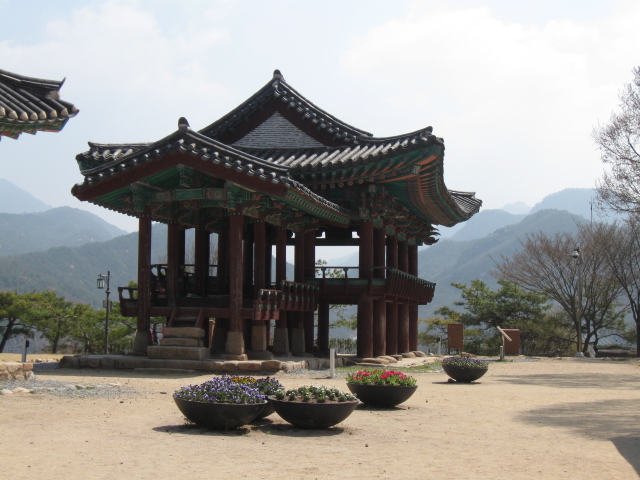
Being a tour, I didn’t have time to take nice shots, so a lot of them don’t make the cut. But I’ve already shown similar photos in the past. Here’s another one of these pavilions. So lovely.
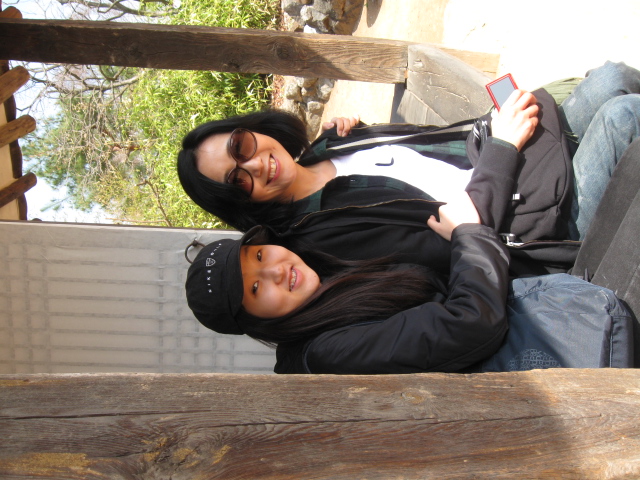
Here is Suwon and Miwha sitting on the porch of a traditional laborer’s home that had been preserved and moved when the nearby dam got built.
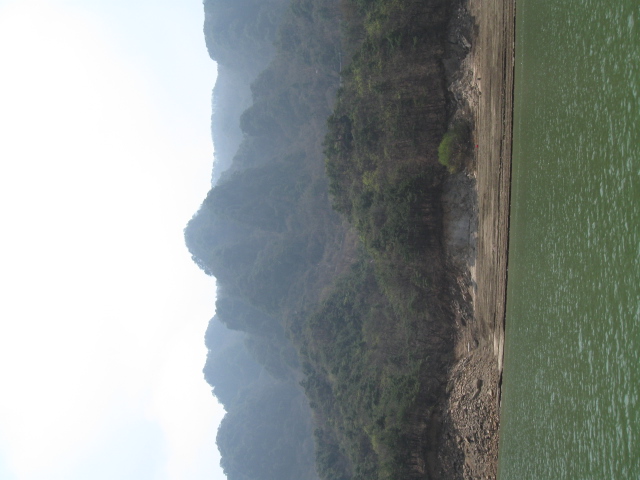
After that we ate at a mushroom restaurant and were told we would go on a ship. The ship was a little tour boat that went around the dam’s lake – so the lake has the same kind of feel to it as Chuncheon, where there is no natural beach but the mountains just rise out of the water. But here the mountains are actually more mountainous, due to the steep limestone.
One of many gorgeous views from the boat. On every boat is an MC and a karaoke machine. And, unfortunately, they like to use microphones in Korea and everybody is a star. Suwon was really annoyed because everyone was old and because they go on these tours but do the same thing they do everywhere and don’t enjoy the nature around them. Which I agree with, but it didn’t annoy me because they were so cute…Here’s a little video footage of them having fun.
As you can see, Koreans ARE NOT timid. AT ALL. Insecure around new things, yes, but not timid.
Afterward, we were dropped off and were told we could choose from one of two hikes but that we had to be back in 4 hours. Surprise! This is a hiking tour! The only way to get Suki to go on a hike, I guess, is to not tell her she’s going on a hike. So here I am on my second hike in Korea.
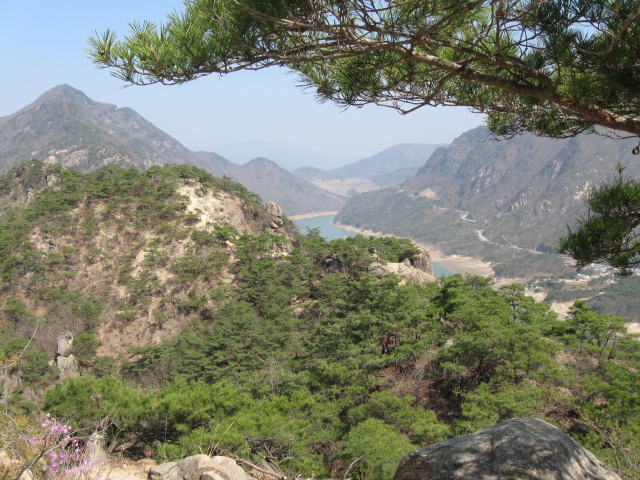
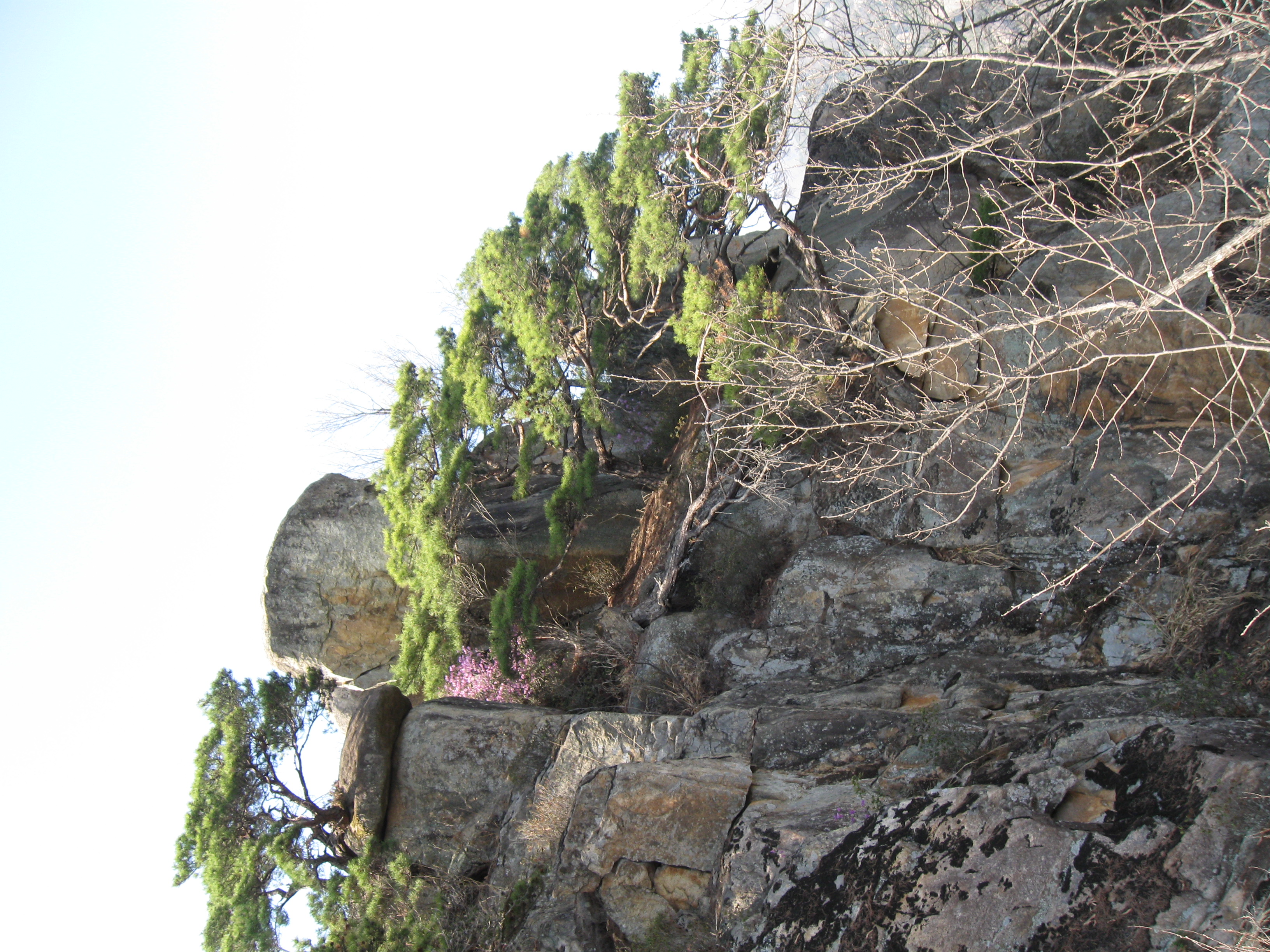
As you can see, it was very beautiful. The stuff of those ancient paintings…
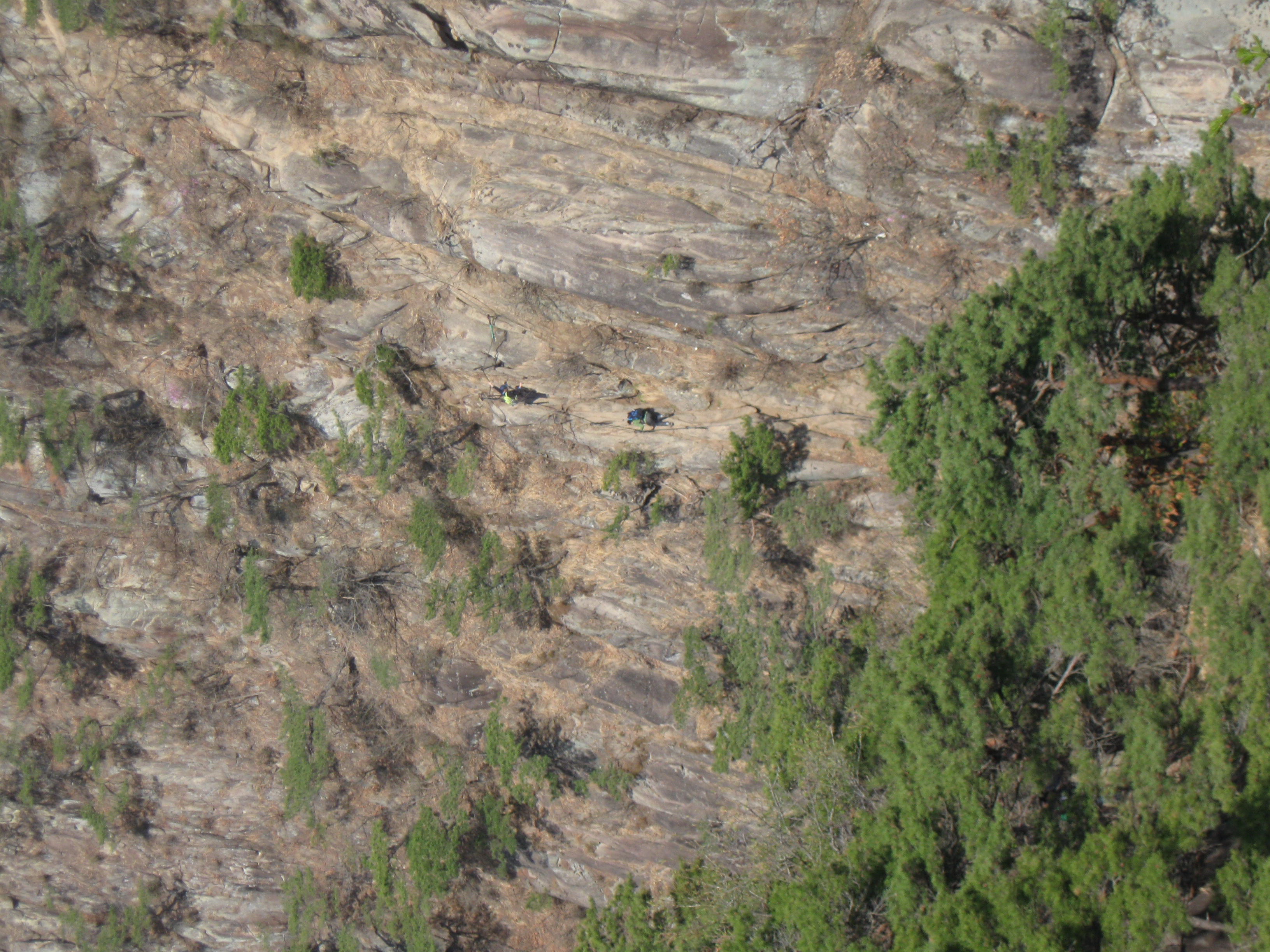
It was also extremely treacherous – no WONDER Miwha called and asked me for all my passport info, etc., so she could buy traveler’s insurance! But seriously – these hikes are really dangerous.
The thing about hiking in Korea is that the hikes are all heavily heavily trafficked. They’re often on the steep side, but they’re also very short so very manageable. But the other thing about hiking in Korea is that the nature of the topography makes it impossible to have safe trails. At every other turn is an edge you could totally fall off of and there’s not going to be any guard rail. On this trail, there’s also no soft bushes or earth to land on – only rock. And this one was treacherous not for the rock but for the ground rock debris lying on the rocks, which was like sand, which even the best hiking boots would wipe out in. So you were slipping all the time. Finding cleared rock free of sand was key…
You know, you look at terrain like this and wonder how anyone could have ever survived in it. But then you hike with Miwha and her daughter, and (much more than other Koreans, actually) every couple of steps they’re exclaiming over finding some particular plant and telling me all the things you can do with that plant. I wish I could take notes fast enough or be able to transcribe the language correctly and photo and catalog all they say. Pretty much everything we passed you could eat in some way…They would joke as we walked over some foliage. “lunchee! lunch! more lunch!” Wild strawberries, wild carrots, a root similar to ginseng, pine nuts, needles make good tea, bark, this flower is edible, the nectar from this flower is good for this ailment, etc. I keep telling them to write a book but they dismiss it and say that all Koreans know this stuff. But I don’t think that’s true and certainly not all Koreans have the vast array of jars of different dried herbs and concoctions that Miwha regularly mixes together and has in her refrigerator and it certainly won’t be true twenty years from now.
On this particular trail were two portions that were practically vertical rock faces. It was really fun and easy, though I had to psyche myself up for it. And the old folks were right there all the way.
Looking down from the top.
Such stunning beauty. Unfortunately, it’s spoiled by the amplified sounds of the tour boat MC’s and the party music. Miwha and Suwon were grousing that they were sick of hearing the same old songs every day…Songs, they tell me, from the time of the Japanese occupation. These songs the old folks hold onto, as if they are anthems, because I think for them they are songs of unity and hope.
My old knees did okay, but I was worried because we only had one half litre bottle of water between the 3 of us. The Korean guys were, of course, drinking makkolli at the top. The only annoying time I had was with the Americans traveling with other Koreans who we met at the top. I started to chat them up in English and they just shut that down right away, probably because I’m Korean and they’re only concerned with being the star foreigners for their own group of Koreans and don’t want to give out free English practice (cough) to me…they were also really stupid, the things they were saying in English…
Hanging out with the old people was really good for me. You know, not long ago I used to look at old Koreans and have such mixed emotions. I’d be ANGRY because they’re the ones who threw me away while wistful that they held the key to Korea’s past and maybe my past. But these days I just accept that they had to make some tough choices and their government and those who directly profited from American deals who are really to blame. I think it’s really those who are now middle-aged, the ones my age, who sold their soul and the soul of Korea…for a slice of prosperity. And the youngest ones therefore have no compass as a result. And this profit by any means mindset has become institutionalized. And I now agree with all those who I talk to at any length who take me aside and advise me not to get my hopes up about Korea changing any time soon. Because Korea is part of the G20 now and the standard of living is really really high and Korea also enjoys some of the lowest taxes in the entire planet. (5% for the general public up to 10% for the wealthy) And the rich are not going to give that up easily. THIS is the main reason why the social services in Korea are so piss poor…and why babies are still sent away for adoption for lack of viable choices.
Suwon has been doing a lot of reading about America, since she’ll be studying abroad next year. She tells me that Korea has copied everything bad about America but none of the good. And I kind of agree with her. And then she tells me she hates Korea. And I’m embarrassed, because the whole bus knows I’m an American and an ajumma is listening in and I’m hoping she doesn’t think it’s my influence.
And so it goes with Korean youth, who recognize how spiritually bankrupt Korea has become and who feel repulsed by the legacy handed them yet unable to attain the promise of anything better.
And so Suwon goes to America to study. During our walk I instruct her on how to get the most out of her American lessons. I tell her to be sure and ask the teacher for clarification or to repeat something if she doesn’t understand it, and that she must advocate for herself. She tells me that she tried that in her Korean classes and was hit, because you’re just supposed to remember the answer and not understand why, and that to ask is to question the authority of the teacher…
I tell Suwon it’s amazing she knows so much about plants and what they can do for health, and she says that it’s because she spent a summer with her grandmother, who taught her. I tell her she should write it all down. But she tells me it’s too late, because she’s forgotten most of it.
I have faith Korea will get better. But it’s going to require a lot more Suwon’s going abroad and bringing back a new way for a new era. And it’s going to take a long long time. And I hope Korea doesn’t forget everything and that it manages to find a healthy identity for itself.



 Hello Korea !